You can’t look around when you’re looking up, so we’ve had a look around for you.
If you have cloud news that you think we should include here, please email it to us at: hello@cloudappreciationsociety.org.
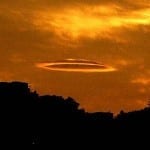
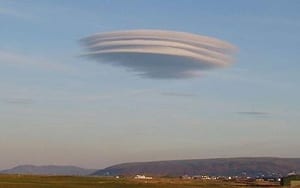
Chris Jackson of Wellington drew our attention to this strange cloud formation that was seen over Island Bay.
Lenticular clouds or Altocumulus standing lenticularis, like this one are stationary clouds that result from strong winds over rugged terrain and form at high altitudes.
Lenticular clouds are common around the Wellington region. They can generally be seen over Mt Orongorongo in the Rimutaka Range.
Nicky Schroder, member 8032 has drawn our attention to this article in the BBC news.
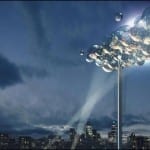
This unconventional structure was originally envisaged as a centre piece of London’s Olympic village and has been shortlisted in a competition set up by London Mayor Boris Johnson who has committed to build a tourist attraction in the Olympic Park “with a legacy for the east end of London”
The giant “digital cloud” would “float” above the London skyline and would include 120m tall mesh towers and a series of interconnected plastic bubbles used to display images and data.
The Cloud, as it is known, would also be used as an observation deck and park.
Funds to build The Cloud would be raised by ‘micro-donations’ from millions of people. “It’s really about people coming together to raise the Cloud,” Carlo Ratti, one of the architects behind the design from the Massachusetts Institute of Technology (MIT) told the BBC.
“We can build our Cloud with £5m or £50m. The flexibility of the structural system will allow us to tune the size of the Cloud to the level of funding that is reached.”
The size of the structure will evolve depending on the number of contributions, he said.
For more information about The Cloud and how to make a donation can be found here
Corina Duyn, a member of the Cloud Appreciation Society has written to let us know that she has published a book entitled “Cirrus Chronicles – Landing in Ballynelligan”.
It is a story about a Cloud Fairy who lives on Cloud Nine, and lands by accident in Ballynelligan, near Lismore in Ireland. It is Magic Realism for ages 8-10 and for all the other children between 4 and 104!
You see sample pages of the book and purchase it through her website
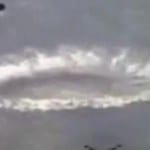
We were sent a photo of a luminous ring-shaped cloud hovering over the Kremlin in Moscow recently. A video of this cloud was posted on YouTube and it soon became a world news story, prompting many to claim that it was of a supernatural nature or a UFO or some sinister government-sponsored experiment.
The story appeared in newspapers around the world, all of which reported the exact same story (e.g. in the UK: The Sun, The Daily Mail, Metro; in the US: New York Daily News; in China: China Daily News). An unnamed Russian meteorologists was quoted, saying ‘This is a purely optical effect, although it does look impressive.’
We are stunned that no one knows that this is a straightforward and fairly common cloud formation, called a fallstreak hole. It is not an optical effect, nor is there anything paranormal about it. We wrote a Cloud of the Month about it a few years back. There are tonnes of photos of fallstreak holes on our photo gallery, sent in by members.
Have journalists stopped bothering to ask questions before printing a story? Can the so-called meteorologist really not know that fallstreak holes form quite regularly all around the world? Clearly, our mission to persuade the world to look up and notice the clouds is far from over.
Noctilucent clouds float much higher than other clouds, allowing them to shine when the sun is below the horizon.
The New Scientist reports that an experiment aimed at creating an artificial noctilucent cloud at the edge of space could shed light on the mysterious high-altitude objects. At the end of September a rocket was launched to create the artificial cloud.
To read the full report, view the gallery and see a video of the experiment click here
The Ocean Youth Trust are a youth charity dedicated to getting young people out on the water sailing and have a 68 foot oyster ketch Lord Rank on which they do it.
They are now offering cloud watching sailing trips with a discount for Cloud Appreciation Society members. To make a voyage viable the Trust would need 12 people who would like to take part. This can be for an afternoon, day, or longer depending on what you are interested in doing. If you are intested please contact the Trust directly and they will collate the enquiries into a database and once they reach 12 they will then identify the voyage date for that group.
Ben Craig (Youth Development Coordinator) of the Ocean Youth Trust Ireland said “We are of course very interested in clouds as weather dictates when and where we can go with our yacht, so we would love to have a group of people onboard who care as much about the weather as we do.”
If you are interested in taking part please contact Ben via their website www.oyti.org
Russ Clark of Arizona, USA was sent this video by his daughter who lives in the LA Basin.
The footage was shot by Dan Black from his vantage point at Tarzana, California.
Gavin Pretor- Pinney, founder of the Cloud Appreciation Society advises us that it shows a pyrocumulus cloud — a sort of cloud that can form over forest fires, due to all the heat and moisture that they throw up into the atmosphere.
The technical names for cloud formations are conventionally Latin words chosen to match characteristic shapes but The Chambers Dictionary knows that there are other ways of talking about clouds.
In their latest blog they talk about ‘goats hair’ and ‘mairs-tails’ and the poetry of clouds as used by Joni Mitchell and Shakespeare…
They also make reference to the new cloud classification. It is a shame though that they didn’t talk more about the use of clouds as a negative metaphor in English especially since this is the sort of thing we need to stand up against!
Cloud Appreciation Society member Robert Woodward, an amateur photographer, has just recently created a photography book called “Clouding About” which contains various cloudscape photographs taken over the past year and a half, at different places around the world.
Robert says “It is by no means a completely polished piece of work but I would like to do some shameless promotion to fellow cloud lovers and if possible get some votes for the competition that it’s in”.
He points out that this version will become a collectors edition and won’t be in print for very long.
To see more about this book and cast your vote please visit here
WORKSHOPS, TALKS AND PRESENTATIONS 8th to 23rd August 2009…
This summer the National Trust’s Tattershall Castle will be dramatically transformed by a team of exceptional artists including video makers, textile printers and landscape designers. Newly commissioned art works will spread throughout the building’s vast empty paces including the turreted rooftop and gardens.
Cloud Spotting
On Sunday, 16th August, Ian Loxley the Photo Gallery Editor for the Cloud Appreciation Society will take you on an informal tour of the afternoon sky. You will learn how to identify the common cloud types as well as many rare and unusual clouds. A gentle paced walk and talk, this is an opportunity to relax, look up and marvel at the Lincolnshire sky.
2pm – 3pm FREE. Booking essential – please call 01526 342543 to book a place or view details of other events here
Partly Cloudy is the new short film by Pixar. It was directed by Peter Sohn a Pixar animator who also provided the voice for Emile in Ratatouille.
The story revolves around Gus, a grey cloud who, with the other cloud people, creates the babies that the stork delivers to earth. He specialises in scultping ‘dangerous’ babies and as his creations become more and more lively his stork partner, Peck, has to work harder and harder…
We all agree that clouds add beauty and interest to the sky – but what about the clouds we can’t see?
Sub-visible cirrus clouds cover approximately 80% of the tropical Western Pacific but are too faint to be seen from the ground. Scientists need Lidar (laser-based radar) and other instruments to track them although they may be seen edge-on as a faint presence from the air.
As these clouds are not currently used in models for climate change meteorologists need to answer the question of how these huge, invisible clouds affect infra-red radiation.
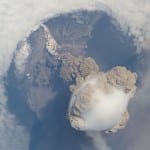
Russia’s Sarychev Peak Volcano erupted for the first time in 20 years on 12th June 2009. This photograph was taken by the Astronauts aboard the International Space Station who where flying directly overhead.
It has been called one of the most dramatic Earth-science photo’s ever taken from space and shows the pillar of ash punching a massive hole in the cloud layer. The misty ‘cap’ on the ash plume is thought to be water condensing from air shoved upward by the rising ash column, similar to the iridescent pileus clouds.
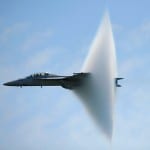
On May 23, 2009 over Wantagh, New York a cone of water vapor surrounds an F/A-18F Super Hornet airplane as it approaches the sound barrier during the New York Air Show at Jones Beach State Park.
Rings like this can form as an aircraft traveling low over the water nears the speed of sound. Pressure created by sound waves squeezes moisture from the air, creating the “artificial cloud.”
Cloud Appreciation Society member, Keijo Rikala, has sent us details of an exhibition to be held in Espoo near Helsinki.
From 5 June to 13 September 2009 at the Gallen-Kallela Museum, the summer exhibition will lead visitors to the sources of meteorological phenomena. It particularly focuses on clouds and their numerous forms. The exhibition offers a journey from horizons glowing red with the setting sun as depicted by Finnish romantic artists to foreboding thunder clouds, fantasy scenes and personal moods.
The LABORATORIA Art & Scient Space invite you to the opening of CLOUD HARP by Nicolas Reeves in Moscow at LABORATORIA Art&Science Space on July 2.
LABORATORIA is the first nonprofit research centre in Russia focused on constructing the platforms of interdisciplinary interaction between contemporary art and science.
The Cloudspotter’s Guide has recently been translated into Russian and the CLOUD HARP was mentioned in it.
Besides the CLOUD HARP itself LABORATORIA will have an exhibition, CLOUD ATLAS which is supposed to give the holistic view on clouds and the cloudspotting. Artists as well as scientists – aerologists, meteorologists, physicists and glider pilots have been invited to share their professional and personal views and attitudes on clouds.
The more we learn about it the more we are fascinated by the beatiful and complicated world of clouds.
Visit the LABORATORIA Art & Scient Space website here.
Cloud watcher Fiaz Kauser has sent us an article which discusses cloud formation in the Koran, a religious scripture dating back 1,400 years.
God has said in the Quran:
“Have you not seen how God makes the clouds move gently, then joins them together, then makes them into a stack, and then you see the rain come out of it….” (Quran, 24:43)
Cloud Appreciation Society member Giselle Goloy’s spectacular cloud photograph made the front page of a leading national daily newspaper in the Philippines earlier this year –
The same shot landed on the cover of the 2009 calendar produced by the Cloud Appreciation Society.
Kikk.K is a Scandanavian designed stationery and gift supplier. They have recently launched and entire range of stationery inspired by Clouds. Its called the ‘Luft’ range which means ‘Air’ in Swedish.
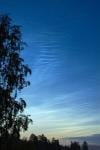
Now is the ideal time to view Noctilucent clouds. These very high, and rather mysterious, clouds are at their best between June and August in the Northern Hemisphere. They are lit by sunlight in the middle of the night and tend to be a milky-blue and very thin so are only noticeable against the dark night sky. If you see them, you should report your observations Noctilucent Clouds Observer’s Group
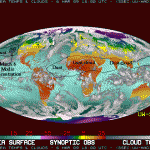
Craig Dremann, member number 14313 writes that dust clouds from the Gobi desert, may be helping to cause California drought. He adds that daily cloud pictures, taken this spring during the drought in California show the affects. This outline world map illustrates how the dust concentrations are supressing cloud formation.
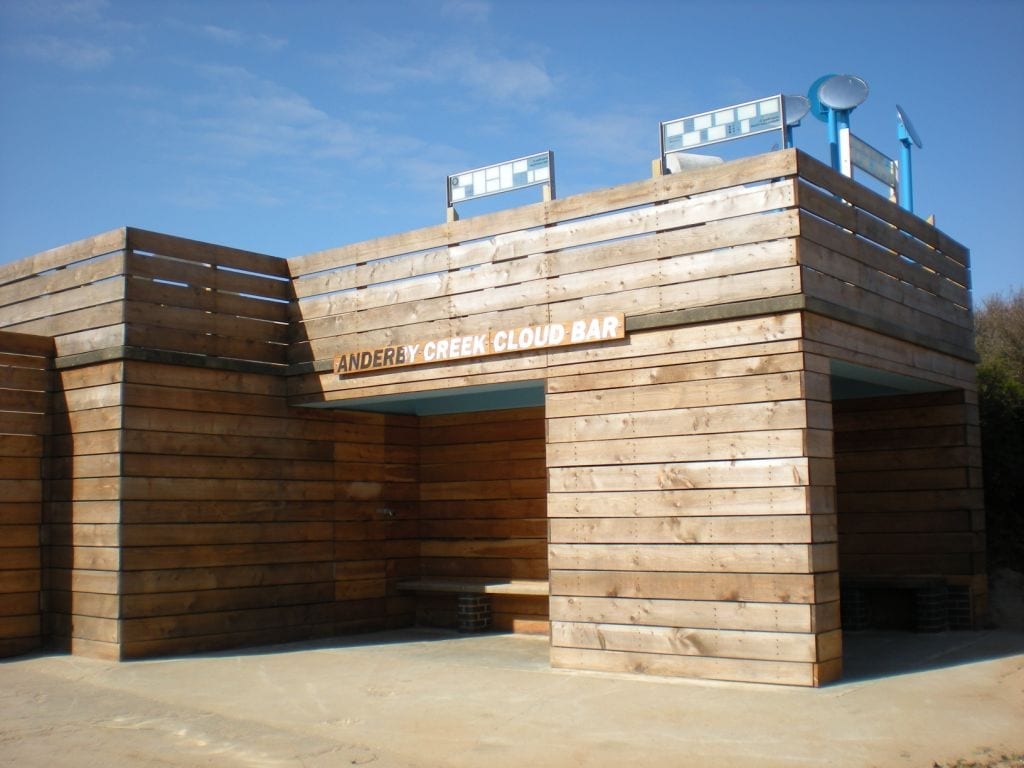
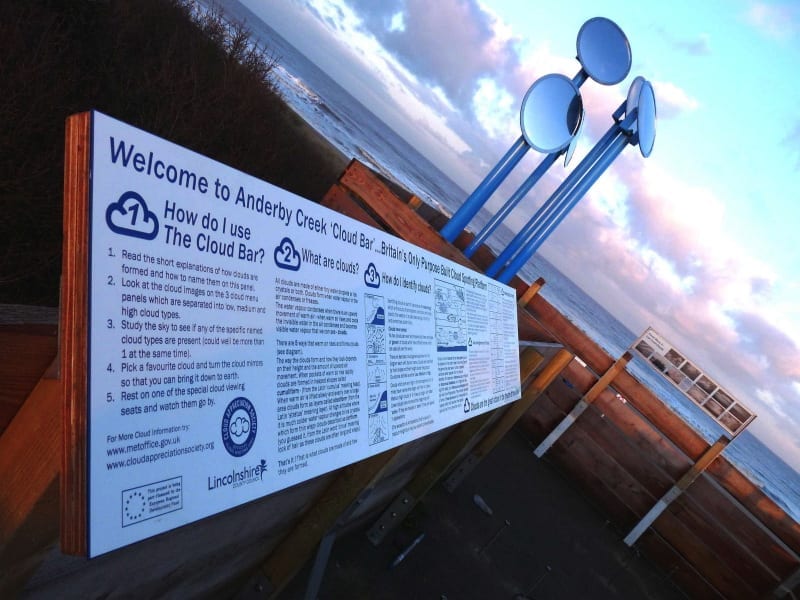
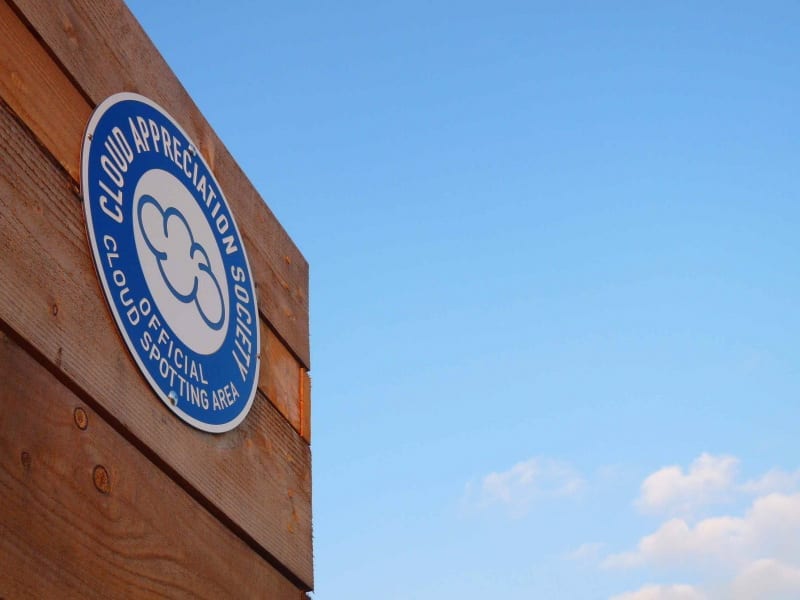
It may not serve any booze, but the Cloud Bar on the beach at Anderby Creek in Lincolnshire, UK, has been sanctioned by The Cloud Appreciation Society as the world’s first ‘Official Clouspotting Area’. And, since it’s launch on 1 April 2009, it is now open to the cloudspotting public.
The Cloud Bar was the idea of artist, and CAS member, Michael Trainor. Replacing a disused beach shelter, the handsome wooden structure looks out to sea from this unspoilt stretch of the Lincolnshire coastline. On the viewing platform, are ‘Cloud Menus’ identifying the different formations, mirrors that can be swiveled to reflect different parts of the sky and specially designed cloud-viewing seats, on which visitors can recline and enjoy the view.
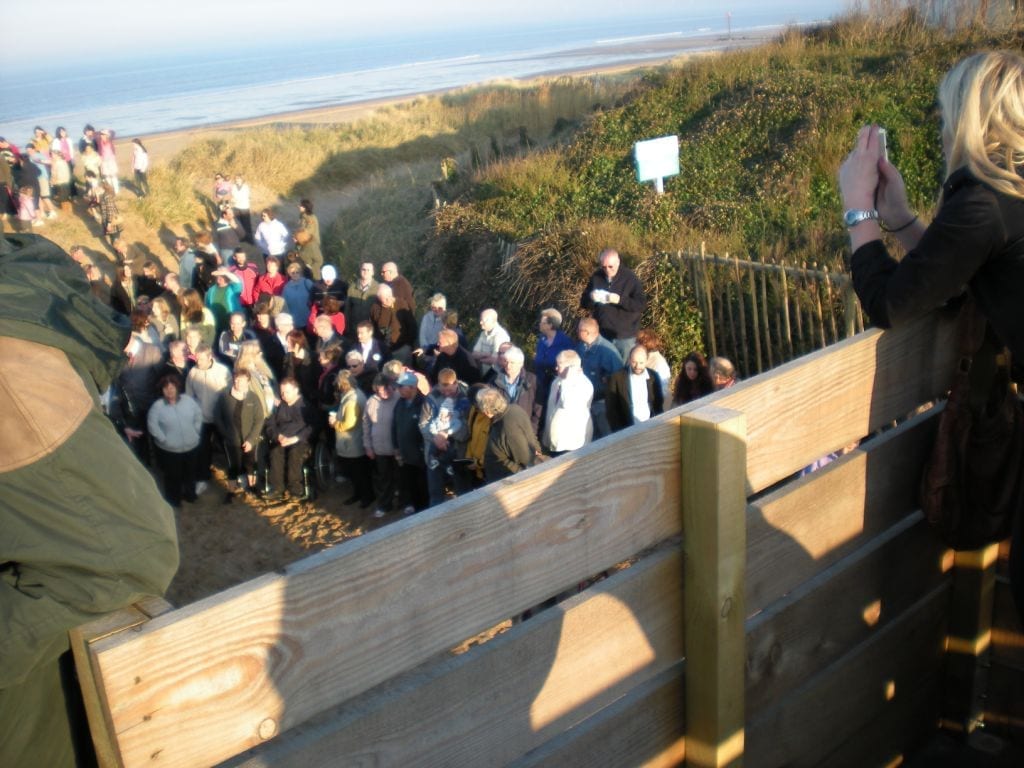
Local members of the Cloud Appreciation Society and Society photo gallery editor, Ian Loxley, attended the opening ceremony, in which BBC weatherman (and Society member), Paul Hudson, cut the blue ribbon. It was a shame that the event was rather marred by the weather: there was barely a cloud in the sky.
A rather more dramatic visitation had arrived the month before in the vicinity of Mt Rainier in Washington State, US. Some photographs of this extra-terrestrial cloud event were sent into the society’s Cloud Gallery (e.g. here and here).
The iPod application, called iDaydream, allows you to create your own clouds in a virtual sky by swiping your finger over the screen to create little puffs. These cloudy creations then float across the sky and shift shapes in the breeze. You can control the wind direction, speed, and turbulence level to change the effects.
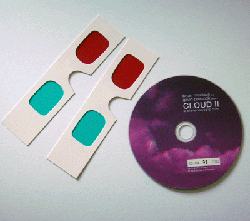
For those of you who do not have a window, or who are wearing a neck brace and so are unable to look up, you can now watch clouds in 3D on your TV.
Artists Brian McClave and Gavin Peacock have produced ‘Cloud II’, a stereoscopic DVD, which you watch wearing some of those blue and red 3D glasses. Since they are artists, they have made DVD in a limited edition of 100, each individually numbered by hand.
Tim Oxton emailed us to tell us five cloud programmes airing on BBC Radio 3, called ‘Head in the Clouds’. They are part of the series called The Essay, and go out every night at 23.00 (GMT) on Radio 3 from 23rd to 27th February 2009.
Thanks to a certain lipstick pitbull, the long-running debate about whether we are responsible for climate change has been given some high-profile coverage.
The fantastic photos taken by our members have helped make our cloud gallery famous throughout the world.
We use cookies on our website to give you the most relevant experience by remembering your preferences and repeat visits. By clicking “Accept”, you consent to the use of ALL the cookies.
This website uses cookies to improve your experience while you navigate through the website. Out of these, the cookies that are categorized as necessary are stored on your browser as they are essential for the working of basic functionalities of the website. We also use third-party cookies that help us analyze and understand how you use this website. These cookies will be stored in your browser only with your consent. You also have the option to opt-out of these cookies. But opting out of some of these cookies may affect your browsing experience.
Necessary cookies are absolutely essential for the website to function properly. These cookies ensure basic functionalities and security features of the website, anonymously.
Cookie
Duration
Description
aelia_cs_selected_currency
1 day
This cookie is used to enable the currency selector functionality of our website.
aelia_customer_country
session
This cookie is used to enable the currency selector functionality of our website.
cookielawinfo-checkbox-advertisement
1 year
Set by the GDPR Cookie Consent plugin, this cookie is used to record the user consent for the cookies in the "Advertisement" category .
cookielawinfo-checkbox-analytics
11 months
This cookie is set by GDPR Cookie Consent plugin. The cookie is used to store the user consent for the cookies in the category "Analytics".
cookielawinfo-checkbox-functional
11 months
The cookie is set by GDPR cookie consent to record the user consent for the cookies in the category "Functional".
cookielawinfo-checkbox-necessary
11 months
This cookie is set by GDPR Cookie Consent plugin. The cookies is used to store the user consent for the cookies in the category "Necessary".
cookielawinfo-checkbox-others
11 months
This cookie is set by GDPR Cookie Consent plugin. The cookie is used to store the user consent for the cookies in the category "Other.
cookielawinfo-checkbox-performance
11 months
This cookie is set by GDPR Cookie Consent plugin. The cookie is used to store the user consent for the cookies in the category "Performance".
PHPSESSID
session
This cookie is native to PHP applications. The cookie is used to store and identify a users' unique session ID for the purpose of managing user session on the website. The cookie is a session cookies and is deleted when all the browser windows are closed.
viewed_cookie_policy
11 months
The cookie is set by the GDPR Cookie Consent plugin and is used to store whether or not user has consented to the use of cookies. It does not store any personal data.
Functional cookies help to perform certain functionalities like sharing the content of the website on social media platforms, collect feedbacks, and other third-party features.
Performance cookies are used to understand and analyze the key performance indexes of the website which helps in delivering a better user experience for the visitors.
Cookie
Duration
Description
__utma
2 years
This cookie is set by Google Analytics and is used to distinguish users and sessions. The cookie is created when the JavaScript library executes and there are no existing __utma cookies. The cookie is updated every time data is sent to Google Analytics.
__utmb
30 minutes
Google Analytics sets this cookie, to determine new sessions/visits. __utmb cookie is created when the JavaScript library executes and there are no existing __utma cookies. It is updated every time data is sent to Google Analytics.
__utmc
session
The cookie is set by Google Analytics and is deleted when the user closes the browser. It is used to enable interoperability with urchin.js, which is an older version of Google Analytics and is used in conjunction with the __utmb cookie to determine new sessions/visits.
__utmt
10 minutes
Google Analytics sets this cookie to inhibit request rate.
__utmz
6 months
Google Analytics sets this cookie to store the traffic source or campaign by which the visitor reached the site.
peepso_last_visited_page
30 minutes
This cookie is used by the Community pages of our website to remember the last page you visited.
Analytical cookies are used to understand how visitors interact with the website. These cookies help provide information on metrics the number of visitors, bounce rate, traffic source, etc.
Cookie
Duration
Description
CONSENT
16 years 3 months 7 days 8 hours
YouTube sets this cookie via embedded youtube-videos and registers anonymous statistical data.
sbjs_current
5 months 27 days
This cookie is to identify the source of a visit and store user action information about it in a cookies. This is a analytic and behavioural cookie used for improving the visitor experience on the website.
sbjs_current_add
5 months 27 days
This cookie is to identify the source of a visit and store user action information about it in a cookies. This is a analytic and behavioural cookie used for improving the visitor experience on the website.
sbjs_first
5 months 27 days
This cookie is to identify the source of a visit and store user action information about it in a cookies. This is a analytic and behavioural cookie used for improving the visitor experience on the website.
sbjs_first_add
5 months 27 days
This cookie is to identify the source of a visit and store user action information about it in a cookies. This is a analytic and behavioural cookie used for improving the visitor experience on the website.
sbjs_migrations
5 months 27 days
This cookie is to identify the source of a visit and store user action information about it in a cookies. This is a analytic and behavioural cookie used for improving the visitor experience on the website.
sbjs_session
30 minutes
This cookie is to identify the source of a visit and store user action information about it in a cookies. This is a analytic and behavioural cookie used for improving the visitor experience on the website.
sbjs_udata
5 months 27 days
This cookie is to identify the source of a visit and store user action information about it in a cookies. This is a analytic and behavioural cookie used for improving the visitor experience on the website.
vuid
2 years
Vimeo installs this cookie to collect tracking information by setting a unique ID to embed videos to the website.
Advertisement cookies are used to provide visitors with relevant ads and marketing campaigns. These cookies track visitors across websites and collect information to provide customized ads.
Cookie
Duration
Description
IDE
1 year 24 days
Google DoubleClick IDE cookies are used to store information about how the user uses the website to present them with relevant ads and according to the user profile.
test_cookie
15 minutes
The test_cookie is set by doubleclick.net and is used to determine if the user's browser supports cookies.
VISITOR_INFO1_LIVE
5 months 27 days
A cookie set by YouTube to measure bandwidth that determines whether the user gets the new or old player interface.
YSC
session
YSC cookie is set by Youtube and is used to track the views of embedded videos on Youtube pages.
yt-remote-connected-devices
never
YouTube sets this cookie to store the video preferences of the user using embedded YouTube video.
yt-remote-device-id
never
YouTube sets this cookie to store the video preferences of the user using embedded YouTube video.