You can’t look around when you’re looking up, so we’ve had a look around for you.
If you have cloud news that you think we should include here, please email it to us at: [email protected].
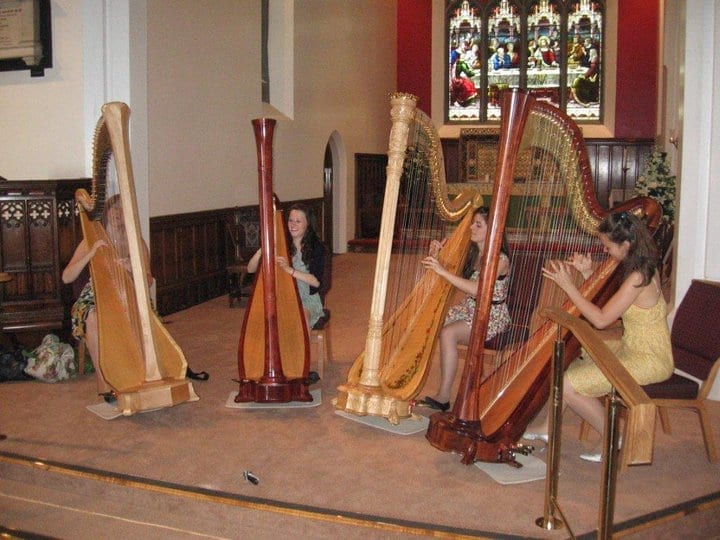
Esther Swift, leader of the Clouds Harp Quartet recently contacted us as she has written and recorded a five movement piece entitled ‘Clouds’for the harp quartet.
They recently completed their first UK tour to promote this, their debut CD, and will be playing at the Bridgewater Hall, Manchester on the 13th and 14th December. Details can be found here.
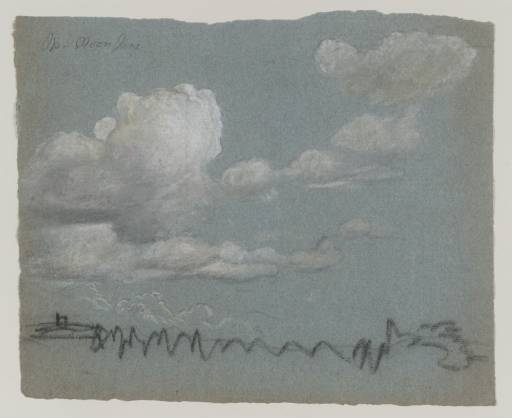
'Landscape with Billowing Clouds' by Thomas Kerrich
Mary Cooper, Member Number 23844, has been in touch to tell us that an art exhibition currently showing at the Tate Britain in London, UK, might be of interest to cloudspotters. Mary told us that “there is a whole room dedicated to the most wild and wonderful paintings of clouds, or ‘skying’ as Constable called it”.
She goes on to explain that the exhibition contains “exquisite chalk sketches by Thomas Kerrich and Down [she wasn’t sure of the name of this artist] dating from before cloud classification, a notebook illustrating techniques for shading in clouds, wonderful Constables (of course) and Turner sketchbooks”. Littered throughout the exhibition are all the amazing Turner cloudscapes that The Tate possesses and, it seems, much more besides.
The exhibition is free. Here are the details and a link to the (minimal) information about it on the Tate website:
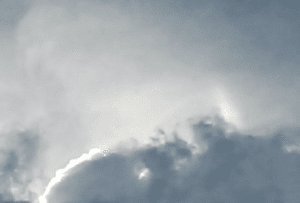
This video of the light effects was filmed over Florida, US
Several members have alerted us to a growing number of amateur videos recording strange shifting light effects appearing above Cumulonimbus storm clouds. These dancing patches of brightness appear to be caused by the cloud’s charged water particles moving around in response to shifting electric fields as lightning strikes within the cloud below.
It seemed to us very unlikely that these strange, shifting reflections of the light could have anything to do with sundogs. In a attempt to find out more, we decided to contact the one Cloud Appreciation Society member who knows most about light effects in the atmosphere: Les Cowley, Member Number 0014, of the fantastic Atmospheric Optics website.
Les took issue with the NASA website explanation, claiming that it is very unlikely these effects are caused the sort of ice crystals that produce sundogs. You just don’t tend to find the right type of ice crystal at the top of Cumulonimbus storm clouds. But if they aren’t moving sundogs, when what are they? “We do not really know what is happening,” Les admitted. “We need more hard evidence, more measurements and cloud-physics modelling before we can hope to come up with a clear explanation. At the moment, we are nowhere near that position.”
And here they are over Batu Pahat, Johor, Malaysia
If scientists need more examples, then surely us cloudspotters are the ones to help. We may not be able to provide physical measurements, but we can surely come up with a few more YouTube vids, can’t we? Anyone who manages to capture another video of one of these beautiful and mysterious dancing storm-cloud light effects can submit it for inclusion on our ever-expanding Cloud Videos page. The first to send a new on in will win a special society prize in recognition of their efforts to help reveal the mysteries of Cumulonimbus, the King of Clouds.
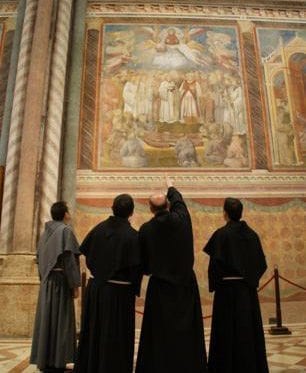
"Surely you see it, Brother? It's over there, just below the angel"
In our first book, The Cloudspotter’s Guide, we confidently claimed that the first painter to depict a cloud that looked like something was the 15th Century Italian painter Andrea Mantegna. The Cumulus cloud he painted in the background of his St. Sebastian (1457-8) looked like a man on horseback. But our claim that he was the first has just been proven wrong. Very wrong.
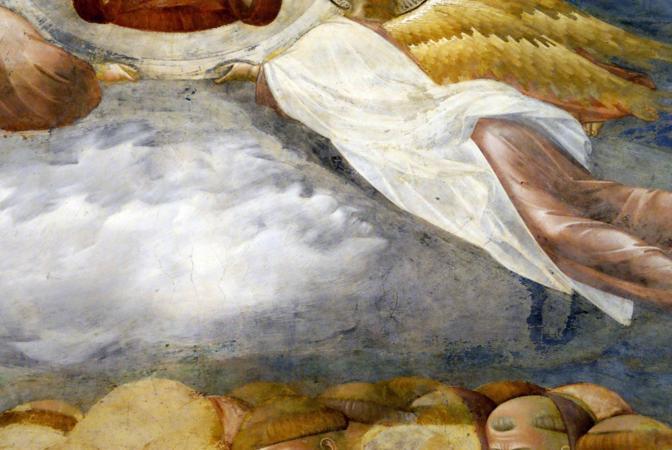
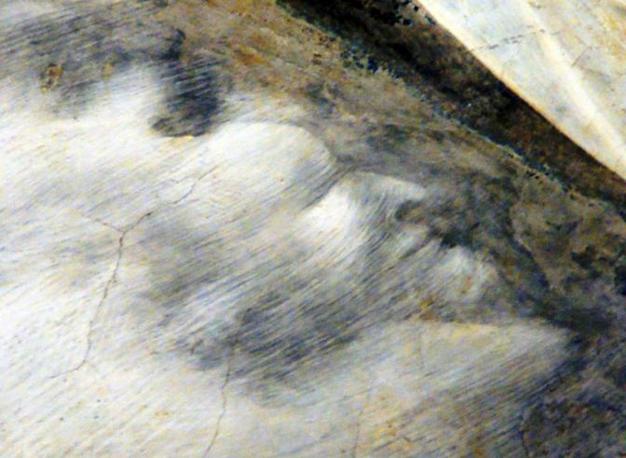
Chiara Frugoni, a cloudspotting art historian in Assisi, Italy, has discovered a cloud shaped like the face of the devil that was painted 170 years before Mantegna’s cloud look-a-like. Frugoni spotted the depiction of the horned face hidden in one of the frescos by Giotto in the Basilica of St. Francis of Assisi. Frugoni has been researching the frescos for the past 30 years, and believes that Giotto’s cloud face was painted in 1289.
In the 720 years since then, thousands upon thousands of pilgrims, tourists and scholars have gazed up and admired the paintings but it seems that no one has noticed the face until now. Though it is hidden within the Cumulus clouds near to an angel, Frugoni claims that “it is very visible” once you notice it. So why hadn’t anyone else noticed Giotto’s cloudy secret for all that time? “One sees what you already know,” said Frugoni. “I assure you that now all will see it.”
We are delighted to have heard of this momentous cloudspotting discovery (and grateful to Antonio Lazzarin of Milan, Italy for drawing our attention to it). Our only disappointment is that Chiara Frugoni didn’t reveal Giotto’s 720-year-old secret just a few weeks earlier. If we’d heard about it then, we’d have been able to mention it in the introduction of our new book before it went off to the printers. ‘Clouds That Look Like Things’ is a going to be a fantastic collection of cloud look-a-likes photographed by members of the society, which will be out in the UK in April 2012. It doesn’t contain a photograph of a cloud in the shape of a Devil’s face. But who needs the Devil, when we’ve got a pretty good likeness of Jesus?
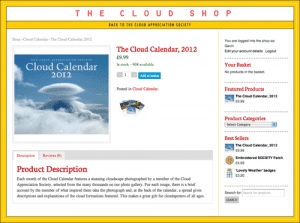
Our new shop system should be easier to use, and paves the way to a single site-wide login for members
We have been working away behind the scenes to set up a new shop system. It now fits in with the look of the rest of the site and, more importantly, is should be easier to use.
There is one drawback in changing over to a new system: people will have to enter their address details as a new customer the first time that they use the new shop. We hope this won’t be too much of a bore, but customers can always buy products without setting up an account. As before, the payments are all obviously handled on an independent and completely secure payment server.
Another advantage of this new shop system is to do with logging in. In the future, we want to set things up so that members can log into the website and get access to pages that normal visitors can’t see. The new shop will be integrated with this, which means that as a member you only need to log in once to access member pages and have your delivery details available in the shop. If you are a member, please tick the box to say so when you log in for the first time. If you can find your membership number you can enter this to help ensure that, when the time comes, you’ll already have a log-in for accessing member-only pages of the website.
If you are a member, please tick the box when you first log in and (if possible) give your member number
Please do tell us here whether or not you find the new shop system works OK for you. No doubt there will be a few teething issues, as there were when we changed over to the new Cloud Photo Gallery, but we hope it will make life easier in the long run.
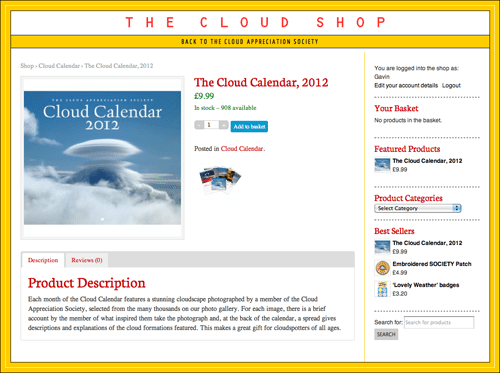
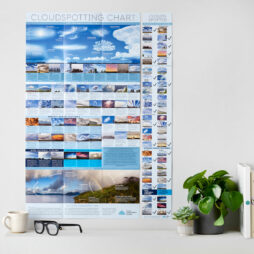
Needless to say, our shop has all sort of fantastic society merchandise on it. We are especially proud of our cloud calendar and new greetings cards:
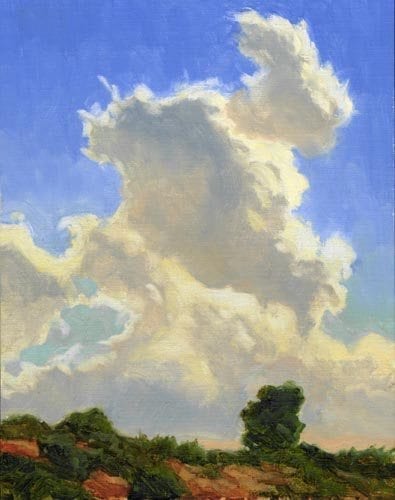
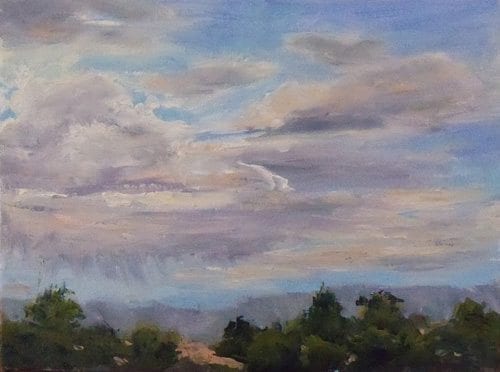
Tom Blazier, Member No. 17,468, got in touch to tell us about the Cloud Appreciation Day that he helped organise on 6 August 2011 for his landscape painting society, the Plein Air Painters of New Mexico.
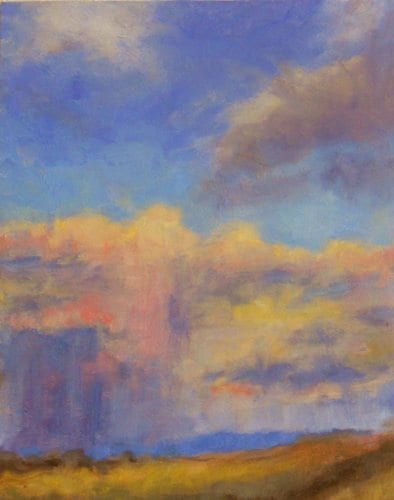
The winning entry: "Ever Changing" (14" x 11" oil on board) by Lee MacLeod
New Mexico is known for its dramatic skies – especially during the summer monsoon when magnificent cumulus buildups are a daily event. PAPNM designated the first Saturday of August Cloud Appreciation Day as a day for its members to celebrate the beauty of clouds by painting directly in the open air rather than in the studio. The paintings are a snapshot of how the sky looked in various locations on the same day as interpreted in each artist’s style.
Participating members painted the sky on August 6 2011 and entered digital photos of their paintings in the contest. Members then voted for their favorite painting from among entries exhibited online. The winning cloudscape was “Ever Changing” (14″ x 11″ oil on board) by Lee MacLeod of Santa Fe. Lee will be awarded with a membership certificate, button and gift from The Cloud Appreciation Society to be presented at the PAPNM annual meeting in December.
Earlier this summer, Sally McKenna (Cloud Appreciation Society Member No. 20,711) organised ‘The First Irish Cloud Festival’ in the West Cork region of Ireland. The idea was conceived in conjunction with Hans Wieland (Member No. 27,412) to bring together Irish cloud lovers and, more specifically, the Irish chapter of the society, known as ‘The Irish Cloud Appreciation Society’.
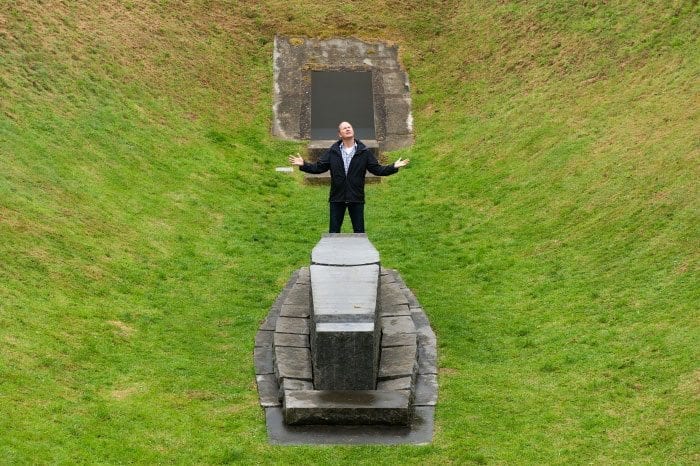
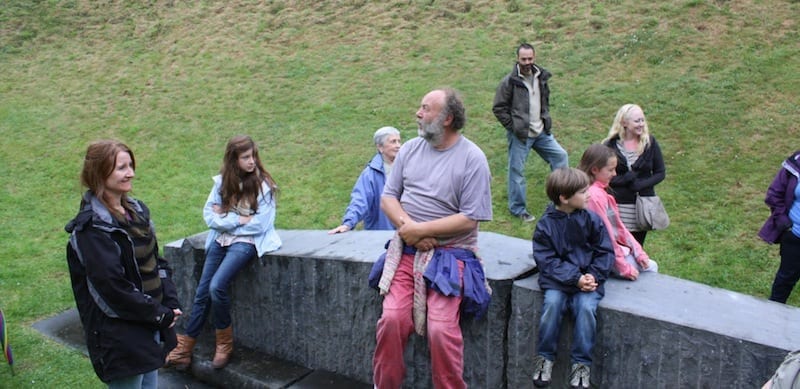
The cloud festival was held in Skibbereen, and proved a great success, with visitors coming from all four corners of the country to listen to talks on cloud-related themes and to do a bit of collective cloud gazing. The cloudspotting part took place in the ‘crater’ made by the Californian artist James Turrell within the grounds of the Liss Ard Estate. This amazing man-made structure acts as a sort of amphitheatre of the sky, the crater rim serving to frame the skyscape above as you lie down and look up from its centre.
Of course, the clouds did not behave as requested. They never do. The day before and the day after were perfect for cloudspotting, but the day of the Cloud Festival itself was veiled in what can only be described as the boring cloud: wall-to-wall Altostratus. No one seemed bothered, however. After all, where would we be if the clouds simply did what we wanted?
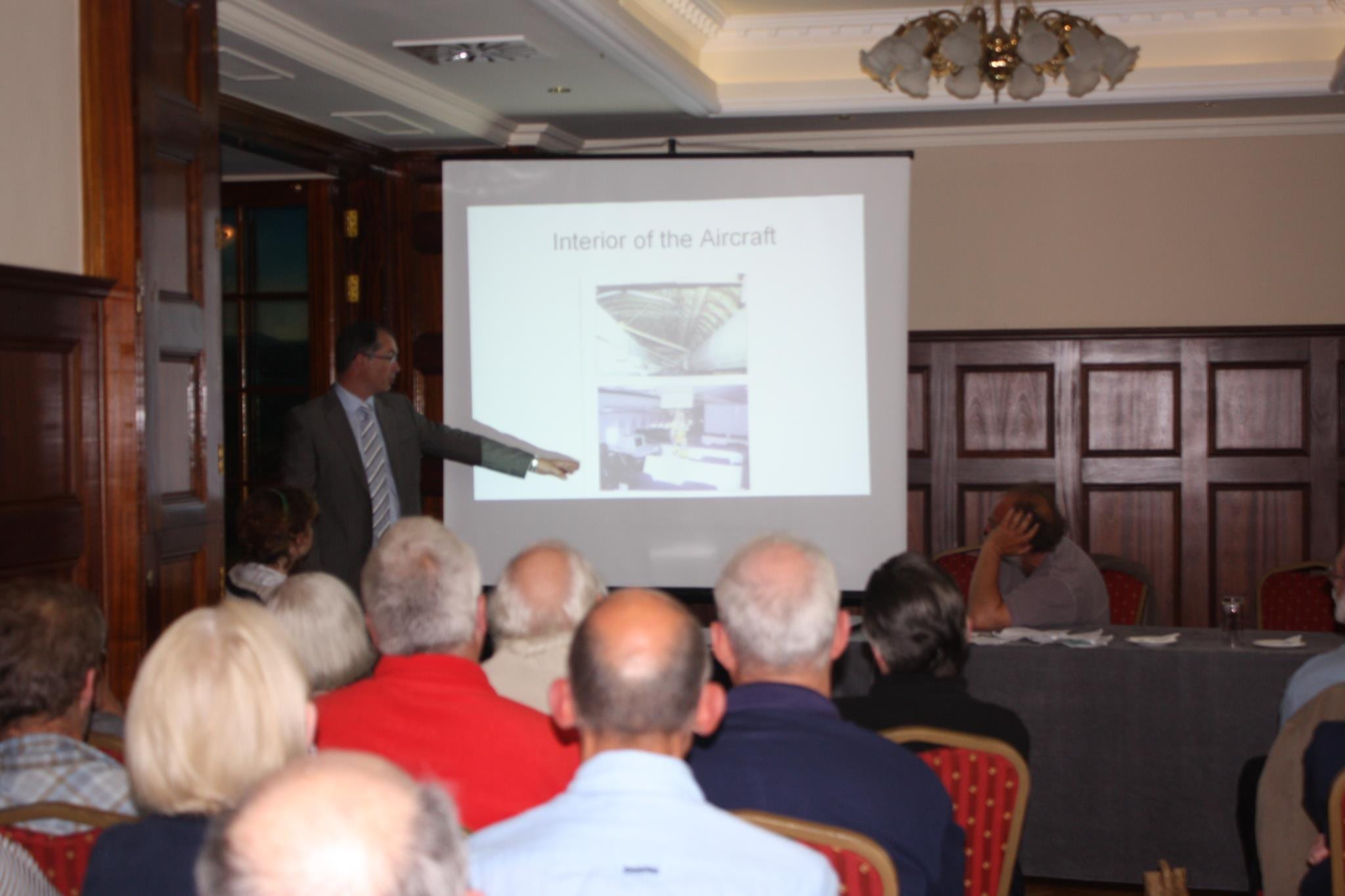
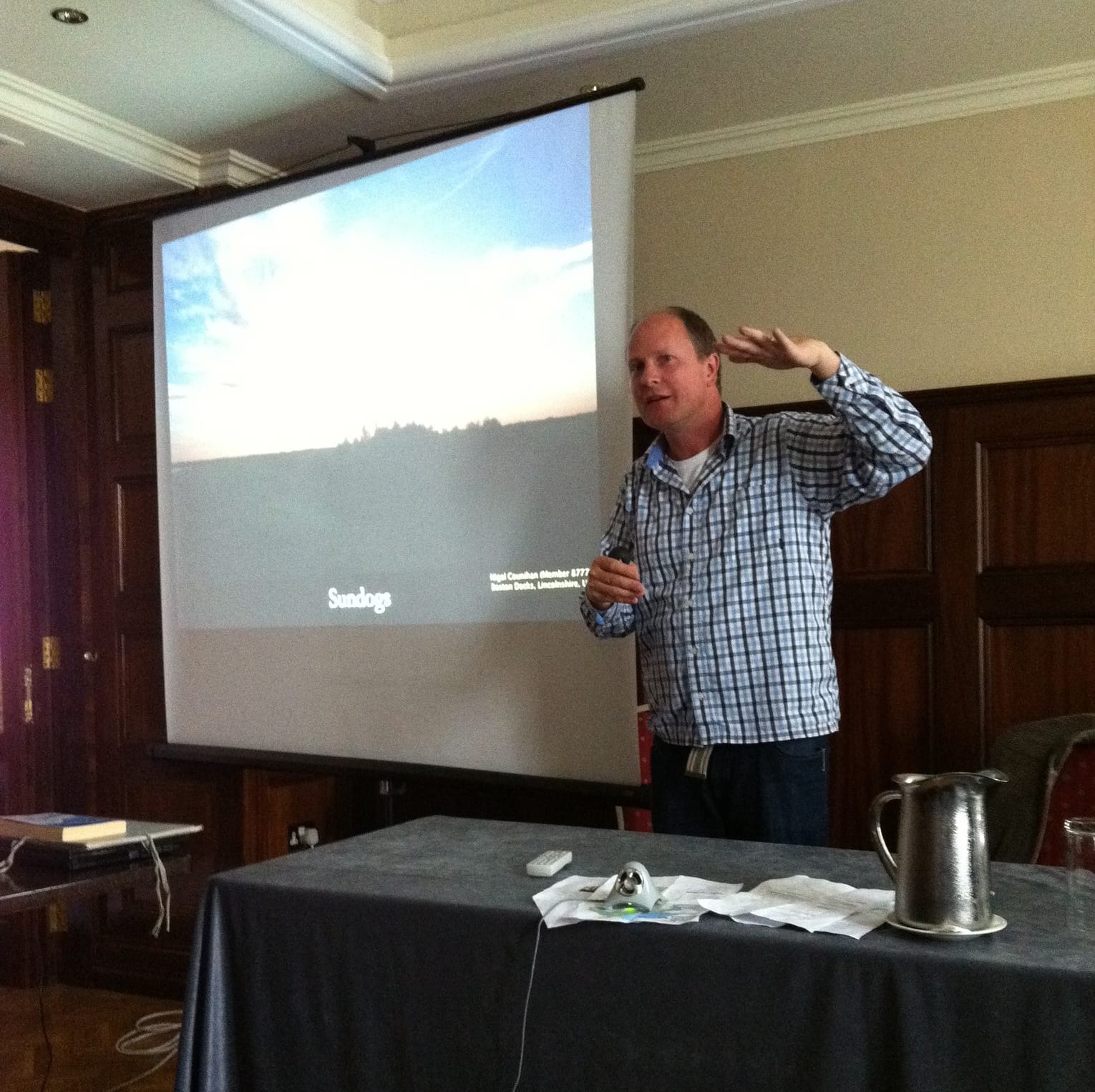
Cloud Appreciation Society founder, Gavin Pretor-Pinney, was delighted to be invited over over to West Cork as one of the speakers. He gave a talk entitled ‘Cloudspotting For Beginners’. Amongst the other speakers were Colm Conyngham, who gave a fascinating and harrowing account of when he got closer to a cloud than he ever wants to be again. He had a terrifying ordeal onboard an Air France flight over Africa on a plane that had a faulty weather radar, and as a result flew directly into a Cumulonimbus storm cloud. Though still suffering from memories of the ordeal, which resulted in many injuries amongst the passengers and crew, Colm accepted a Cloud Appreciation Society badge and is working towards wearing it in an effort to put the whole thing behind him. Also speaking were photographer John Baylis Post on how to take successful sky photos, Ian Carruthers, a local storm chaser and John McKenna on the theme of clouds in New Yorker cartoons.
There is already talk of organising another Irish Cloud Festival in 2012, perhaps this time in Sligo on the north west coast. Anyone interested in this idea can join the discussion on the Irish Cloud Apprecaition Society Facebook page: http://www.facebook.com/topic.php?uid=108602662490872&topic=401
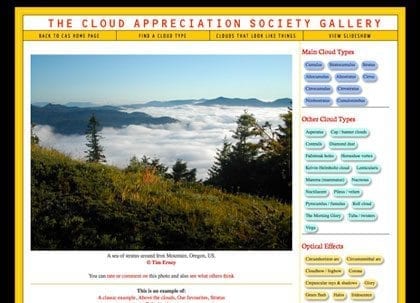
If you’ve taken a look at the society’s cloud photo gallery recently, you might have noticed that it has changed. We’ve been working feverishly in the background to update the gallery system and introduce some improvements that we hope you will appreciate. Inevitably, there will be teething problems as the new system beds in, but these are the reasons why we think that the new system is an improvement on the old:
Larger images, faster, easier to search...
• The new page width matches the rest of the site. This means we can now show images larger than before. Please note, however, that the images loaded up at the size to fit the old system now look rather titchy but we are hoping to up-size many of the old images over time.
• We have streamlined the system so that the 7,500 or so pictures on our gallery load more quickly.
• It is now much easier to search for specific cloud types. When you click on the Find a Cloud tab at the top of the page, you can select cloud classification terms in the sidebar. By clicking on these tabs, you can narrow your search to very specific types of cloud formation. If you want to unselect a tab, just click it again.
• You can now click on a photographer’s name and see all the images that they’ve got on the gallery.
• When you hover your mouse over an image, forward and back arrows appear at either side. Click these to advance through the found set of images.
• When you click the View Slideshow button at the top of the page, the slideshow plays using the set of photographs that you’ve just found. In this way, you can view a slideshow of photographs from a particular photographer or of a specific type of cloud.
• You can now rate a picture and leave a comment about it by clicking in the middle of the image. This shows it in detail view. (Being able to easily go back from this detail view to where you were is something we are still working on!) In future, we plan to introduce a way of finding the most popular images.
We have tried hard to come up with a system works both for those who want to be able to search for very specific cloud types and those who just want to see pretty pictures of the sky. Thanks to all our fantastic members and visitors who have contributed their photographs, we have what must be the most extensive gallery of cloud photographs in the world. We’d love to hear what you think of the new way of viewing them.
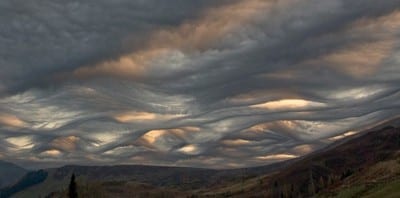
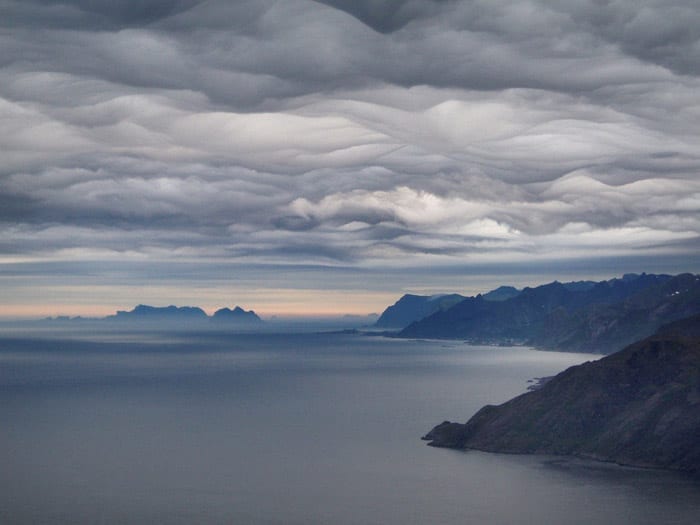
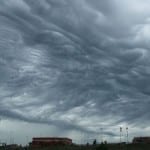
Members and visitors might remember that a couple of years ago we proposed that a new classification of cloud should be added to the official classification system. Photographs of this cloud formation had been sent in by Society members over the years, and we’d never known quite how to classify them since we felt that they didn’t easily fit into the existing cloud terms.
The cloud looks a little like the surface of the sea on a choppy day, which is why we proposed that it should be called asperatus from the Latin verb ‘aspero’, meaning to make rough. The term was used by Roman poets to describe the sea as it was roughened by the cold north wind.
We felt all this press attention was a little premature as there hadn’t even been time to look into the atmospheric conditions that give rise to the cloud formation. But all the publicity did lead to a huge number of people sending in their own photographs of asperatus clouds they’d spotted, greatly adding to the growing asperatus collection.
Soon, the term was being adopted by cloudspotters around the world. But we always thought it a pretty unlikely to ever be accepted as an official term. This, we were were told by our friends at The Royal Meteorological Society would only happen if it were acknowledged by the World Meteorological Organisation in Geneva, who publish the rather dry but thorough bible of cloud classification, The International Cloud Atlas.
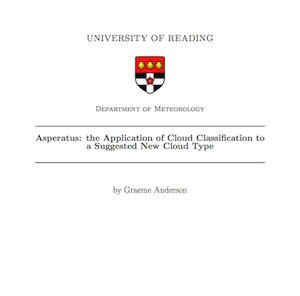
For asperatus to stand a chance of becoming official, we were told, we’d need some idea of the atmospheric conditions that cause it to appear. Finding this out sounded like a lot of work. So we were pleased to learn that Graeme Anderson, an MSc student at the Department of Meteorology, Reading University, had decided to write his dissertation on the cloud, and was happy to trawl through the meteorological records for the dates and locations of the asperatus sightings we’d been sent to try and work out what caused the formation.
By studying the weather records and using a computer model to simulate the cloud, Graeme found evidence that asperatus is formed in the sort of conditions that produce mamma clouds (also known as mammatus), but when the winds up at the cloud level cause it to be sheared into wavelike forms known as undulatus. The conclusion was that there was a case for this being accepted as a new classification – one that is called a cloud ‘supplementary feature’.
The Royal Meteorological Society is now encouraging the international meteorological community to update the Cloud Atlas and include asperatus to make it official. The current edition, after all, was published in the 1970s. If asperatus is accepted, it will be the first official cloud classification in 60 years.
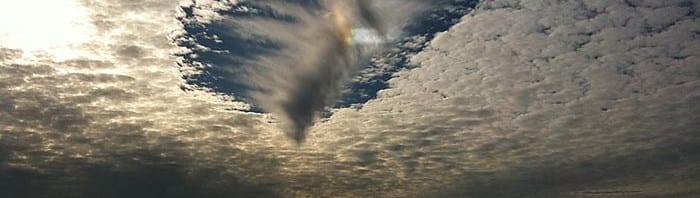
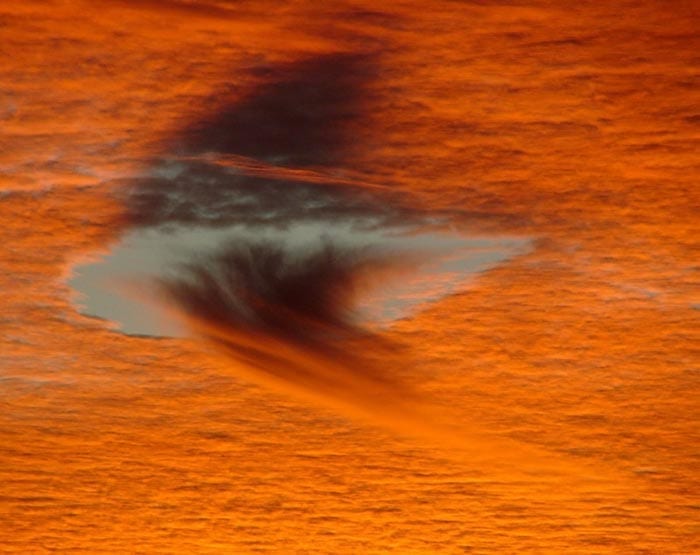
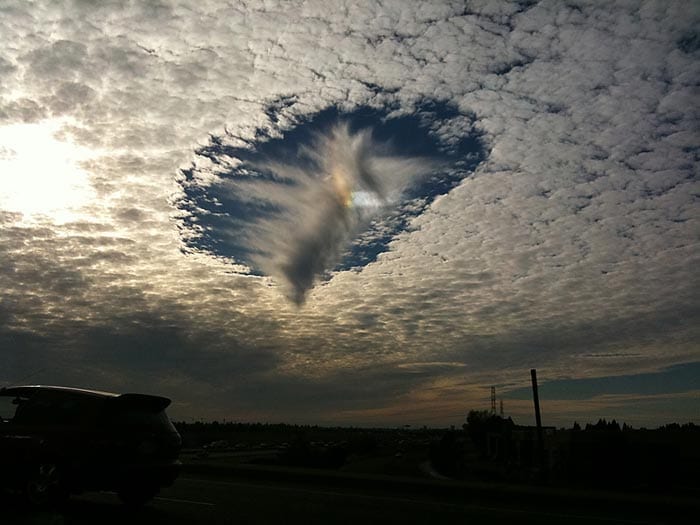
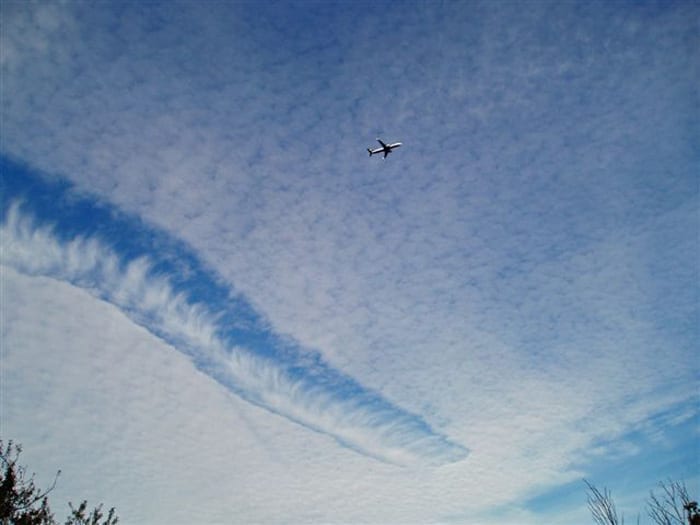
Members and visitors might have enjoyed the fantastic collection of fallstreak-hole photographs displayed on our photo gallery. Also known as ‘hole-punch clouds’ these formations occur when part of a cloud of water droplets freezes into ice crystals. Scientists have known for some time that the effect occurs when the ice crystals grow large enough to fall below as a fallstreak. But what has always been unclear is quite why the freezing starts in one particular region of a cloud layer and how the hole grows in size, sometimes reaching 50km across an hour after the hole began. Now, research published in Science magazine has helped explain some of the mysteries of these beautiful fallstreak holes.
We already knew that, for the hole to form, the droplets in the cloud layer need to be ‘supercooled’. This means that they are at a temperature below 0˚ Celsius, but have yet to frozen. In fact, cloud droplets can and do often remain liquid at temperatures well below the freezing temperature of a glass of water down here on the ground. When in the form of tiny droplets, water needs a nucleus of some sort to be encouraged to freeze – a tiny particle of some sort that it can get started on. Without one of these icing nuceli present, droplets will resolutely refuse to freeze until the air temperature drops to as low as –40˚ Celsius.
But what gets the freezing started in one region of the cloud? The research has confirmed the long-held suspicion that an aircraft flying through the cloud can be enough to set off the freezing process. The expansion of the air as it passes over the aircraft wings and (for certain types of plane) over the blades of its propellers, causes it to cool. This momentary cooling can be enough to take the temperature down low enough for the droplets to start to freeze spontaneously, even though there aren’t enough icing nuclei around for the droplets elsewhere to freeze.
The research also proposed a way by which the freezing water might cause a hole to expand outwards from the point where the plane flew through the cloud. When the droplets change into solid particles, they give off a tiny bit of heat – enough to cause the air to expand and rise a little. In reaction to this rising current, the surrounding air sinks slightly. As the air around the frozen fallstreak sinks and warms up, the droplets there evaporate. This seems to be the method by which the fallstreak of ice crystals produced by the plane climbing or descending through the cloud layer forms a circular hole that appears punched out of the cloud layer.
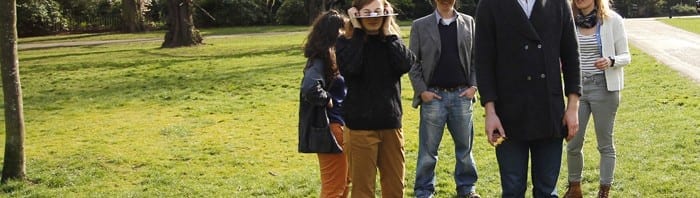
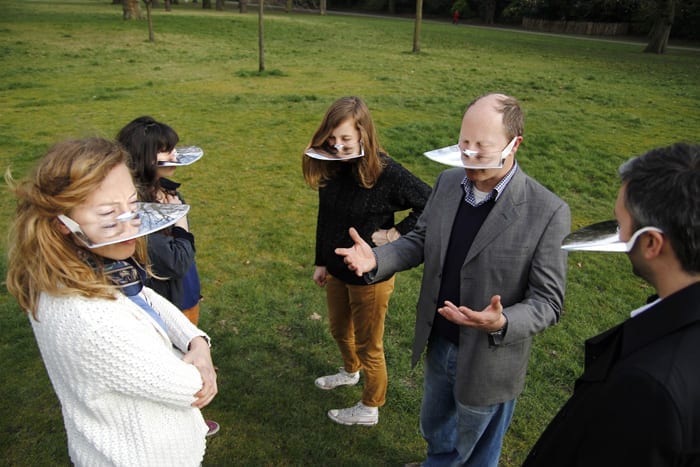
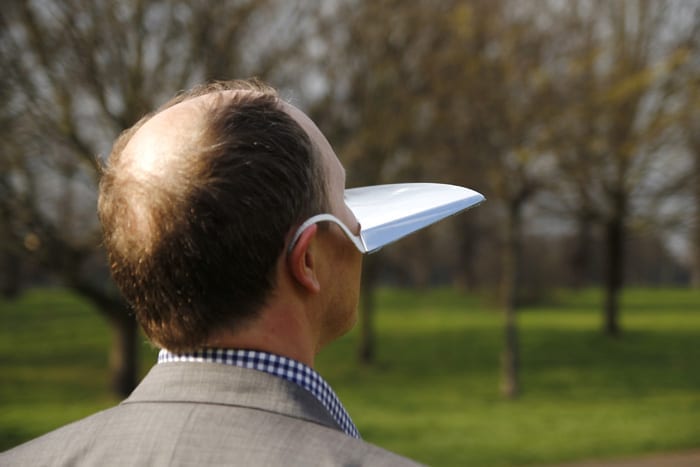
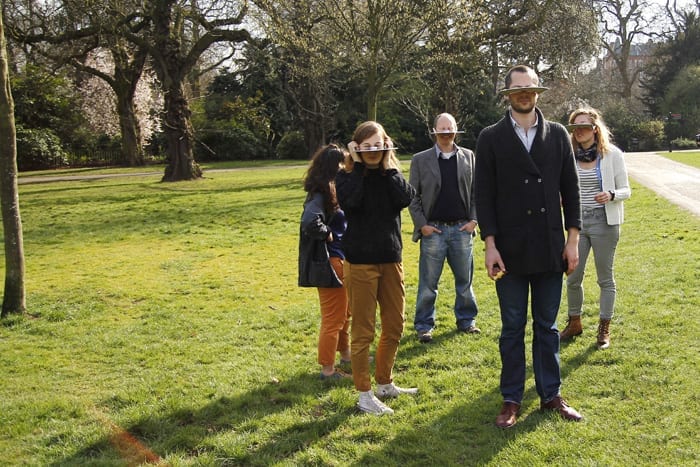
Earlier this year, Cloud Appreciation Society founder Gavin Pretor-Pinney was asked to go on a ‘sky walk’ in London’s Hyde Park by students in Product Design at the Royal College of Art. Intrigued by the sound of this, he went along and was handed a pair of strange mirror classes, created by design student Marjan van Aubel. They act like mirrors that reflect an image of the sky into your eyes as you walk around. The sensation of wearing them is rather weird. It feels a little like flying upside down.
Gavin talked to the students about the clouds that they were all enjoying through the reflections of their sky glasses. He commended Marjan on her fantastic invention. Cloudspotters will love them, but they might not catch on amongst the general public. Anyone wearing them as they walked around London would be run over by a bus within about 10 minutes. They also make you look a bit stupid.
You can see Marjan van Aubel’s work here.
She has no plans to manufacture the sky glasses yet, but I’m sure she’s open to persuasion…
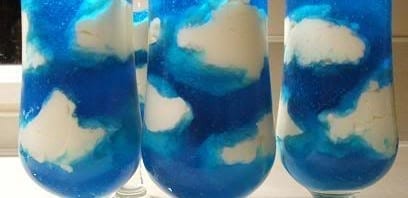
Lorna Stroup Nilsson sent us the link to this cloud inspired dessert. She says “it isn’t terribly easy to get blue Jello (jelly!) in the UK, but I got a pack via Amazon. Anyway, this recipe really does work!”
From Aliens to Astronauts and Classics to the Cosmos, this year we will be reaching for the skies to celebrate Portsmouth: Space City. Inspired by the city’s motto Heaven’s Light Our Guide our programme will mark Portsmouth’s role as a centre of excellence for cosmology, astronomy and space technology – and science fiction will also feature, inspired by the ‘father of science fiction’ former Portsmouth resident HG Wells. Internationally renowned figures from the world of music and the arts, science and technology will take part in a wide range of events including an opening weekend featuring NASA Astronauts Andrew Thomas and Shannon Walker.
Cloud Appreciation Society founder, Gavin Pretor-Pinney will be giving a talk at the Portsmouth Festivities on 22nd June 2011. It is entitled “How to Collect Clouds” – details can be found here
A strange vertical cloud was spotted on the 25th May 2011 off Port Townsend.
Lenore Maranan-Goldstein, the managing director of the Northwest Maritime Center & Wooden Boat Foundation, took these two photographs of the clouds as they sat just off the northern tip of Marrowstone Island.
French speaking cloudspotters might be interested to watch a short feature about The Cloud Appreciation Society filmed for a programme called Nouvo on RTS (Swiss television). The report features Cloud Appreciation Society members Danièle Siebenhaar and Riana Rakotoarimanana, as well as society founder, Gavin Pretor-Pinney.
And if you don’t speak French, you can watch Gavin talking in English about how and why he set up the society and the importance of cloudspotting as an antidote to modern life:
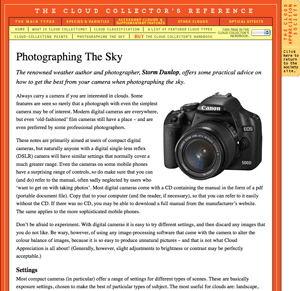
The renowned sky author and photographer, Storm Dunlop, has written a short piece for the Cloud Collector’s Reference section of our website with advice for anyone interested in photographing clouds.
Not only does Storm have just about the most appropriate name for any cloud enthusiast, he also knows a lot about sky photography as he is the author of the classic reference book Photographing Weather. In the piece, he offers helpful suggestions on cameras, settings and filters to help you take the best images of the sky.
Any budding cloud photographers should take a look at Storm Dunlop’s article Photographing The Sky.
Steve Constantelos of Chicago, USA recently wrote to tell us about a photo project he undertook last year.
Each day during 2010 Steve photographed the sky. Steve wrote “Unbeknownst to me, you and your fellow members of the Cloud Appreciation Society have been spreading the message of loving the local and the non-wholly-blue sky that I also hold near and dear to my heart. I am very happy I finally found you”.
Take a look at Steve Constantelos’s photostream to see the shots he has taken so far this year.
Thanks to member Andrew Maclean for sending us the link to this story….
Apparently, scientists at Qatar University claim to have developed artificial clouds to provide shade for stadia and training grounds at the 2022 World Cup.
Qatar, as we know, can get a little bit warm so the plan to air condition their stadia will be welcomed by the players, especially if it works!
But for cloud lovers, who have always marvelled at their beauty at no cost to ourselves, will be amazed that the cost of producing an artificial cloud is £310,000 ($500,000).
The OPAL climate survey is a way you can help scientists investigate how our activities affect the climate – and how the climate may affect us. Dr Geoff Jenkins, Cloud Appreciation Society Member 23638 who is based at the University of Reading, has got in touch to see if C.A.S. members based in England would be interested help with one aspect of the survey: observing the appearance of condensation trails.
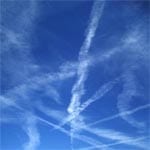
You will all have seen condensation trails, or contrails, in the sky. They are the white lines left behind high-flying aircraft (described on page 63 of The Cloud Collector’s Handbook). The man-made clouds are formed when the air is cold (below about minus 40°C) – usually above about 10km (30 000ft). At this low temperature, water vapour ejected from jet engines (created when fuel is burnt) quickly condenses into ice crystals. If the air is moist enough, the contrail can stick around for a long time, and even spread out to form cirrus-like clouds – and these may be warming the climate (although much less than greenhouse gases do). The purpose of the survey is to try and find out more about how contrails affect our temperatures.
Since Cloud Appreciation Society members are such keen observers of the sky, they would be perfect participants in the survey. And it couldn’t be simpler to contribute. All you have to do is tell the boffins when you see contrails in the sky. They are interested in observations at any time of day and on as many days as possible between March and May this year. You don’t even have to register (unless you want to get a field pack and to keep track of your results). As they come in, the results are added to a contrail observations map.
Understanding the effect of these man-made clouds on our temperatures is of increasing imporance. The ubiquity of air travel means that more and more contrails spread across our skies with every passing decade. So, between now and the end of May (2011), if you are based in England, please contribute to the contrail study by reporting your observations on the OPAL website here: http://www.opalexplorenature.org/contrails
Barbara and Zafer Baran’s first major London show since 2003 includes a selection from two current photographic projects: Turner’s View and Star Drawings. Although different in approach, each series deals with an aspect of the skies and heavens: Turner’s View is an extension of the artists’ earlier, land-based documentary work, and Star Drawings is a product of their lifelong interest in experimental photography, astronomy and drawing.
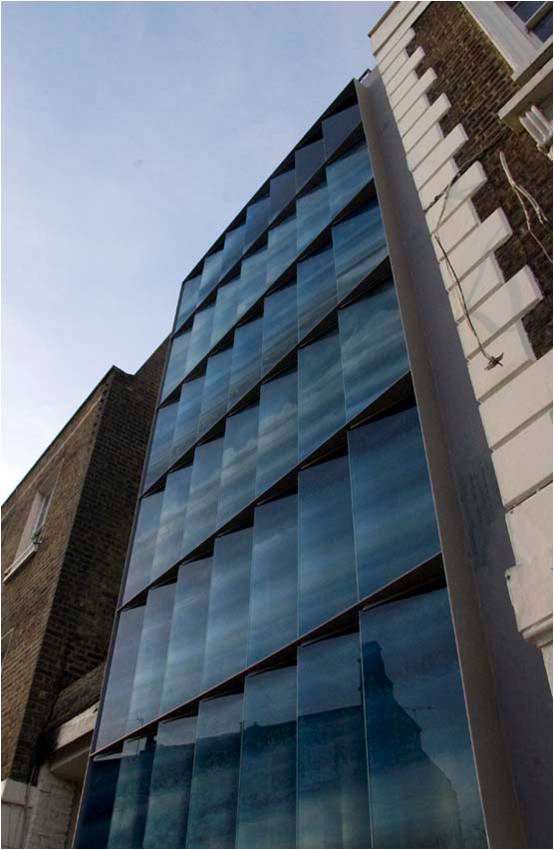
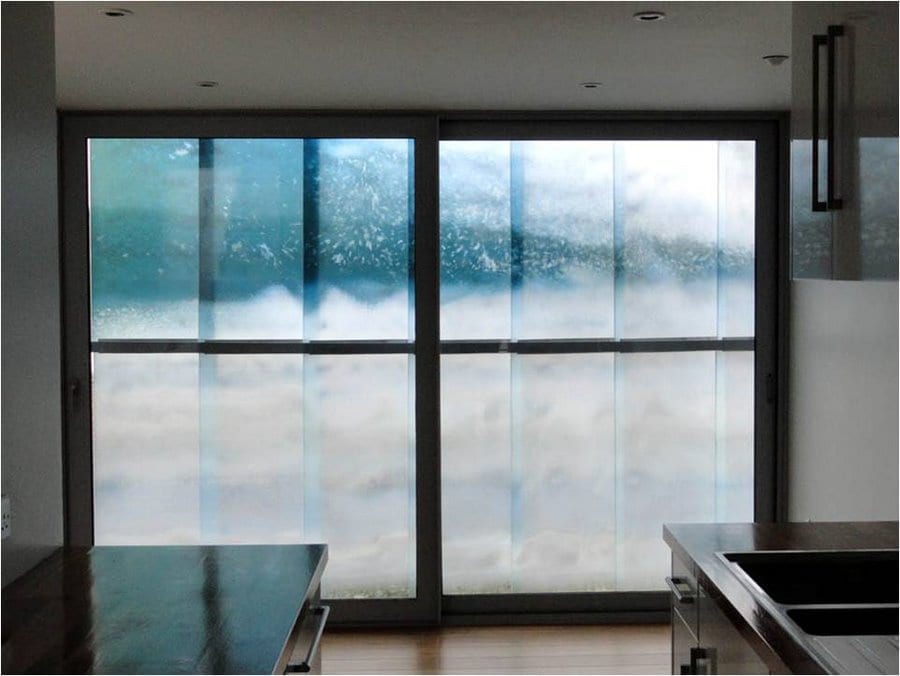
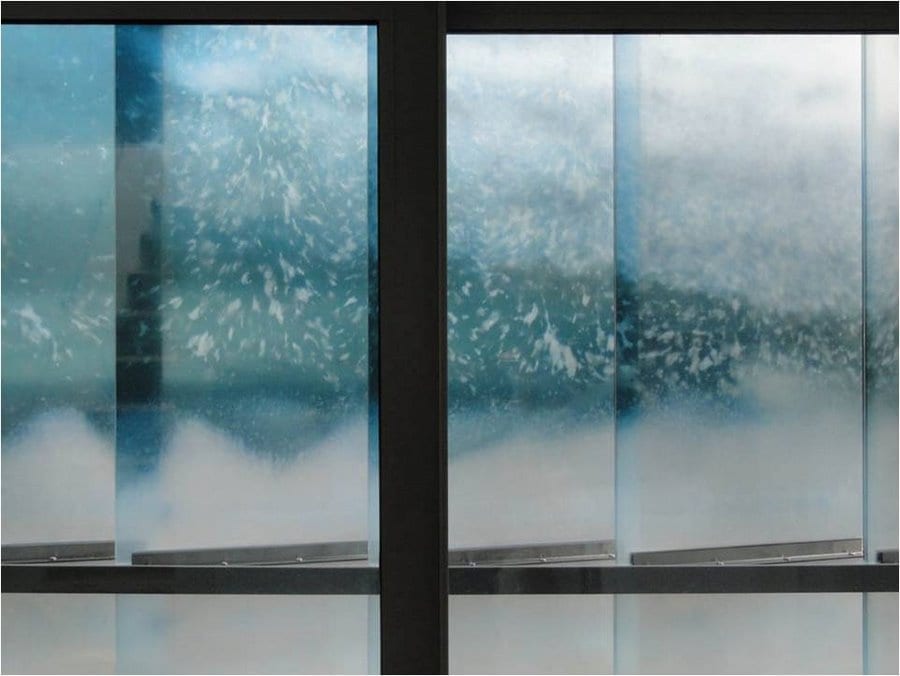
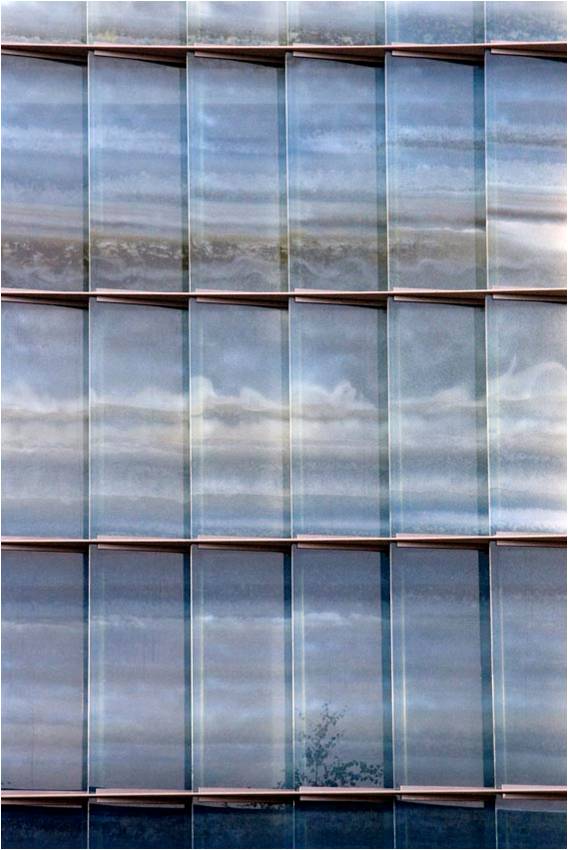
Completed towards the end of November 2010, the front of this private house in Camden by multi-award-winning London architects Patel Taylor features a ‘sea and sky’ image provided by Richard Weston Studio. The image was scanned at very high resolution from an Oregon ‘thunder egg’ – a mineral similar to agage. The image was printed onto silk and laminated between two layers of glass by specialist architectural glass-maker Hourglass of Havant. The silk-in-glass images form a series of angled louvres to provide privacy and reduce heat gains from the sun – laminating films cut out the UV light that would otherwise fade the fabric.
Richard Weston’s carves using mineral images were a big hit at Liberty’s ‘Open Design Call’ last February and their development is to be covered in a new, seven-part BBC2 series, entitled ‘The Next Big Thing’ and scheduled to be broadcast in March-April this year.
Paraglider pilot Kym Fielke has a lot of experience of clouds; watching them, flying through, above and below them.
During 2010 he shot over 8800 photographs to create his master timelapse sequences in South Australia around Adelaide, Mt Lofty Ranges, Fleurieu Peninsula, Mid North and Flinders Ranges.
You can watch this wonderful video and read his account here
Our friends at the Royal Meteorological Society have set up a new club called “The Weather Club”.
You can join for a yearly membership fee of £25.00 and you will receive four copies of their magazine “The Weather” in which Cloud Appreciation Society founder Gavin Pretor-Pinney writes a short column about clouds.
You can visit their website here where you will find more information, features, news and an ‘ask the experts’ section.
Cloud Appreciation Society member Jay Brazzell recently entered this sun halo photograph to a National Geographic photography contest and it has made it through the preliminaries to their website.
Jay says of his photograph “A temperature inversion was the cause of a spectacular sun halo display over Silvercreek/Granby Colorado. When a morning temperature of -27 and a heavy ground fog mingled the result was what started as crystalized water vapor (Diamond Dust) and became a wonderful sun halo followed by a double sun halo.”
Cloud watcher Greg Wright sent through this very interesting article from the Science Daily website.
Meteorologists analyzing data from a closely-packed group of five satellites have identified a decrease in cloud cover over the Arctic. They find this alarming because cloud cover absorbs some of the heat in sunlight, stopping it from warming the surface of the earth. It is possible that this loss of cloud cover is contributing to global warming.
Our friends at “The Weather Shop” have invited members of the Cloud Appreciation Society to their “Winter Weather Wonderland” on Saturday, 4th December between 10am and 4pm.
The Weather Shop is a great location for that speacial or interesting gift for Christmas including complete weather stations, weather forecasters, traditional barometers and more. You can call into their East Sussex store for technical advice and demonstrations or visit their website here
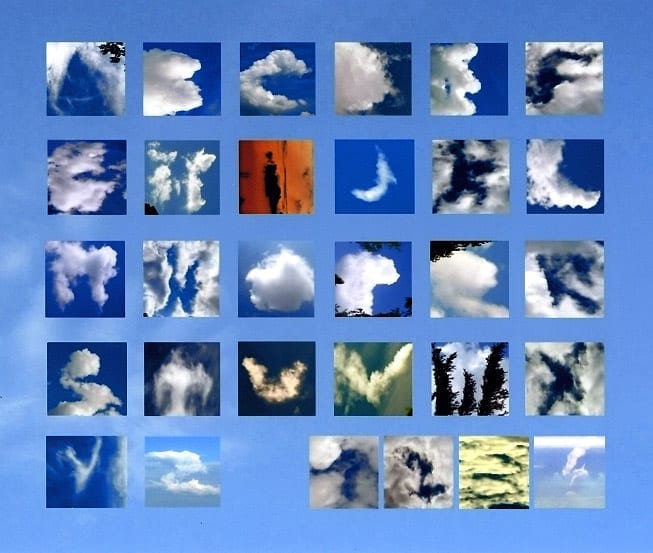
Cloud Appreciation Society member Danièle Siebenhaar who hails from Switzerland has been searching out a cloud alphabet. She has been hunting clouds in the shape of letters and has now found all of them, from A to Z.
Danièle uses her images to produce birthday cards for friends and family. We congratulate her on her achievement, and think that she should release the images as a typeface – that way, we can use it instead of Helvetica when we next send out the Cloud Appreciation Society newsletter.
Her cloud alphabet was reported in the UK’s Metro newspaper and the Swiss newspaper, Tages-Anzeiger. Proud as she is of her collection, Danièle insists that some of her letters don’t look as clear as she’d like, and so she has vowed to continue her important alphabetic quest.
Franz Ossing of the GFZ German Research Centre for Geosciences and Pieter Roelofs of Rijksmuseum, Amsterdam have collaborated to produce an in-depth analysis of Hendrick Avercamp’s work focusing mainly on his skies and the weather depicted in his paintings.
“Hendrick Avercamp almost invariably painted or drew calm and stable weather conditions with stratiform clouds”.
“His painting ‘Enjoying the Ice’ which was done c. 1610-20 shows a layer cloud with cumuliform heaps which meteorologically can be identified as a stratocumulus near sunset”
The full article can be found here and is extremely insightful and informative – well worth taking a few minutes to delve into.
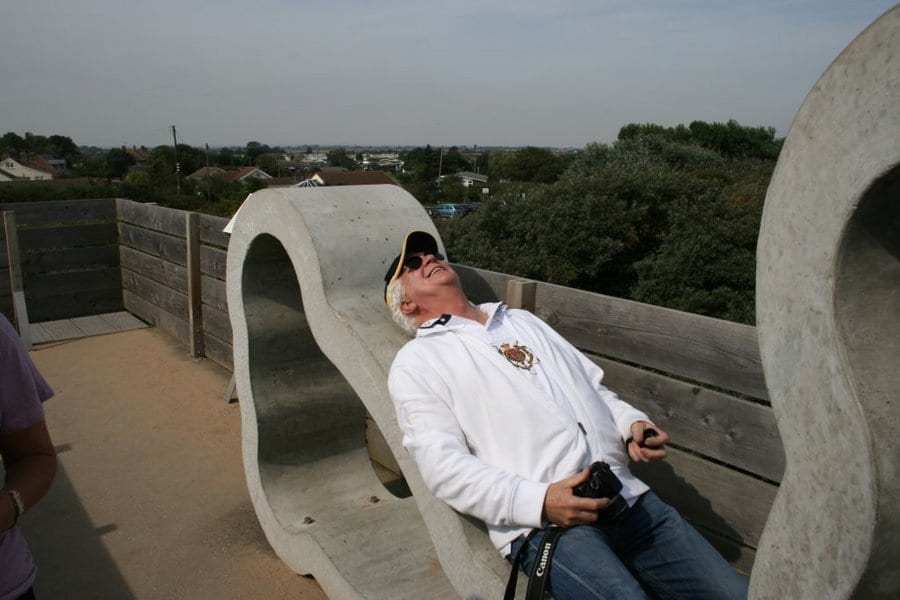
August this year saw Cloud Appreciation Society member Ron Bishop visit The Cloud Bar at Anderby Creek on the east coast of Lincolnshire, we believe Ron to be our furthest travelled international visitor to the Bar.
Ron is a pilot for Qantas airlines and lives near Melbourne, Victoria, Australia. Whilst at the bar he was interviewed by Radio Lincolnshire and gave a fascinating insight into life as an airline pilot and his occupational involvement with, and leisure time interest in clouds.
Ron has submitted a number of photos for the gallery taken from his office window on the flight deck.
Lower cloud formations were not visible during the visit by Ron, Ian the society Photo Editor, and Ian’s Wife Carol, who he stayed over with in Lincolnshire, but high Cirrus and Cirrostratus were observed.
Cloud Appreciation Society member, Kate Jordan-Moore has drawn our attention to clouds being featured at the 12th edition of the Architecture Biennale of Venice.
The exhibition runs from 29th August to 21st November at the Giardini and other venues in Venice. ‘Cloudscapes’ is an indoor cloud created in an 800m2 room in the Venetian Arsenal and forms the central installation in this most prominent of spaces. It was created by German climate engineering company Transsolar and Tetsuo Kondo Architects.
You can see more about the installation here and watch a video here and a further link to images has been sent in by cloudspotter Peter Kaiser.
CAS founder Gavin Pretor-Pinney comments that this is not the first time that clouds have been employed in architecture. It was done most notably at the Swiss Expo in 2002 by the architects Diller and Scofidio who designed the Blur Building which consisted of a cloud created over a lake. You can see more about this here and watch a video of it here
This is the title of a insightful and entertaining article by Christopher Middleton included in the Daily Telegraph on 10th September 2010.
Christopher describes his visit to Britains first Cloud Bar at Anderby Creek near Skegness. He writes “Spend an hour on top of the Cloud Bar (no drinks, it’s a little fort) and you become an instant expert on telling your “altos” (four to six miles high) from your “cumulos” (anything lower). As for “cirros”, they don’t start until eight miles up, identifiable because of their, well, wispiness (cirrus in Latin means a strand of hair)”.
He also gives wide mention of the Cloud Appreciation Society and has some interesting and descriptive quotes from Gavin Pretor-Pinney, our photo gallery editor, Ian Loxley and CAS member Mike Rubin, a glider pilot from Hampshire.
The full article can be found here and includes some cloud definitions at the end.
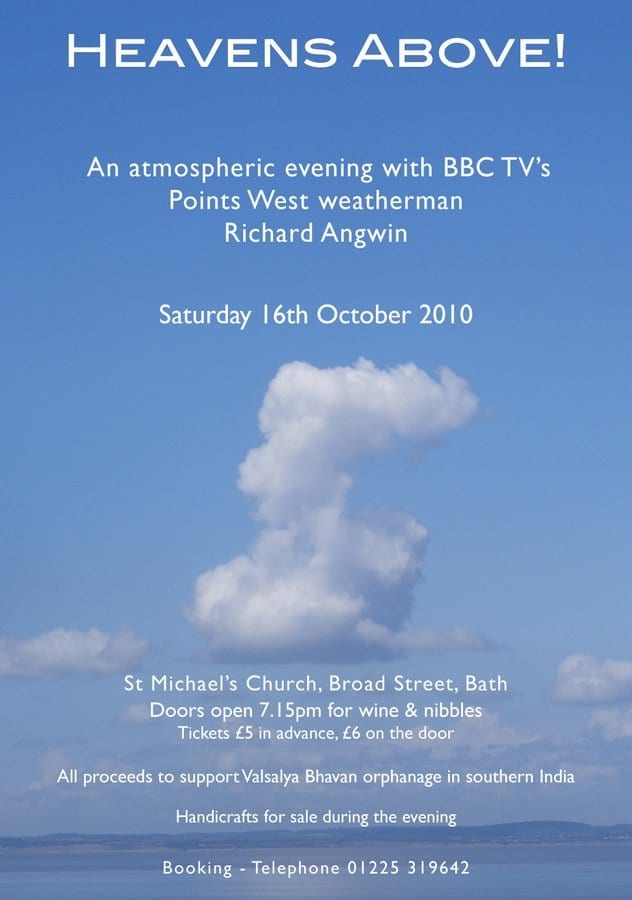
BBC TV’s weatherman Richard Angwin will be attending a charity event in support of an orphanage in Southern India at St Michaels’ Church, Broad Street, Bath. The event will be held at 7.15pm on Saturday, 16th October 2010.
Richard will be talking about “50 years of TV weather” and there will be refreshments available.
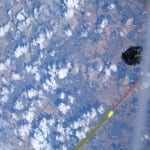
Jamie Costello, Head of Physics at Sutton Grammar School and Cloud Appreciation Society member sent in this image of Cumulus at 20,000ft.
The photograph was taken by a group of children taking part in a school project. He says “It took a good deal of work to get this shot but it was worth it. Google Earth tends to take shots with clear sky. It is lovely to see some of the trails of clouds formed in some of the other photos.”
Sponsored by the Institute of Physics the students created the entire payload including flight computer which modulated a GPS signal into a de-codable radio signal. They also had sponsorship from the Dorking and District Radio society and a donation of batteries from Battery Force.
Jamie added “Although we found the payload, not everything worked and we are going to launch again soon- ish”.
You can see the full project details by clicking here
Karen Kingston, author of ‘Clear your Clutter with Feng Shui’, recently posted a blog entitled “Why cloud collecting can be good for you”. She describes the passtime as “etherically refreshing and psychologically uplifting” – a very apt description!
She gives notible mention to both “The Cloud Collectors Handbook” and “The Cloudspotter’s Guide” although the main focus of the article is how clouds affect our mood on a day to day basis. She writes “looking up is good for you. Just the simple act of looking up when you feel down changes your psychological condition and raises your energy. And developing a relationship with the skies above allows your consciousness to expand to fill bigger spaces and your creativity to soar.”
Radio 4’s ‘So You Want to be a Scientist’ NLC (Noctilucent Cloud) project brings together amateur Welsh scientist John Rowlands, 41, based on Anglesey, with The University of Bath’s Professor Nick Mitchell and his atmospheric research team. John’s entry was one of four finalists chosen by a panel of eminent scientists from over 1300 entries.
Bath University is providing access to the latest VHF radar, based in Sweden and NASA satellite observations to measure wind speeds and temperatures in the mesosphere, where NLC form, which lies some 50 miles (82km) above the earth – about 10 times higher than the highest normal weather clouds. The experiment will try to predict the onset of a cold phase of the 5-day planetary wave, a huge oscillation in winds within the mesosphere that may influence the occurrence of NLC. Later in the summer, John and Nick will try to predict when NLC might form,
and the BBC’s weather service will run a noctilucent cloud forecast on suitably clear nights. They aim to get as many people as possible out under the night sky and enjoying one of nature’s most beautiful and eerie sights.
NLC are predominantly seen in the northern and north-eastern part of the sky from late May until early August each year. The mesosphere is the coldest part of the earth, dipping to about -150 degrees Celsius. NLC ice crystals most likely nucleate on meteoric dust particles, as
this is where shooting stars burn-up as they enter the earth’s atmosphere.
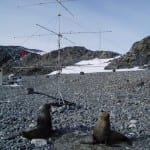
The image above is of sealions and antenna is a VHF radar used to measure the wind velocity within the mesosphere. This one is in Antarctica, but an identical unit based in northern Sweden will be used for the BBC experiment.
There is a Facebook Page (BBC controlled) about the experiment here and the University of Bath Research pages can be found Visit the website here
Jets and turboprop aircraft leave unusually shaped clouds in their wakes. (Credit: Alan Sealls)
Society member David Benn recently came across this article on the Science Daily website.
Mysterious clouds are produced when aircraft inadvertently cause rain and snow. This cloud ‘seeding’ is caused when the aircraft climbs or descends in certain atmospheric conditions and causes narrow bands of rain or snow to form.
This phenomenom has triggered speculation and wonder whenever the blue-sky holes have been sighted, even as far back as the 1940s.
The full article can be found here and is well worth a read!
There are also some very good photographs of hole punched clouds here – thanks to Glenys Chew for this link.
Undulatus Asperatus was first identified last year by Cloud Appreciation Society founder, Gavin Pretor-Pinney and is currently being researched by Reading University.
The US National Weather Service writes:
“Undulatus asperatus (or alternately, asperatus) is a rare, newly recognized cloud formation . . . The clouds are most closely related to undulatus clouds. Although they appear dark and storm-like, they tend to dissipate without a storm forming. The ominous-looking clouds have been particularly common in the Plains states of the United States, often during the morning or midday hours following convective thunderstorm activity.”
You can read more and see some very good photograps here
Kristin Nielsen has drawn our attention to this wonderfully relaxing website. Add gentle rain to your environment. Enhance your music. Sleep Better. Relax.
Listen here and play your favourite music simultaneously
We use cookies on our website to give you the most relevant experience by remembering your preferences and repeat visits. By clicking “Accept”, you consent to the use of ALL the cookies.
This website uses cookies to improve your experience while you navigate through the website. Out of these, the cookies that are categorized as necessary are stored on your browser as they are essential for the working of basic functionalities of the website. We also use third-party cookies that help us analyze and understand how you use this website. These cookies will be stored in your browser only with your consent. You also have the option to opt-out of these cookies. But opting out of some of these cookies may affect your browsing experience.
Necessary cookies are absolutely essential for the website to function properly. These cookies ensure basic functionalities and security features of the website, anonymously.
Cookie
Duration
Description
aelia_cs_selected_currency
1 day
This cookie is used to enable the currency selector functionality of our website.
aelia_customer_country
session
This cookie is used to enable the currency selector functionality of our website.
cookielawinfo-checkbox-advertisement
1 year
Set by the GDPR Cookie Consent plugin, this cookie is used to record the user consent for the cookies in the "Advertisement" category .
cookielawinfo-checkbox-analytics
11 months
This cookie is set by GDPR Cookie Consent plugin. The cookie is used to store the user consent for the cookies in the category "Analytics".
cookielawinfo-checkbox-functional
11 months
The cookie is set by GDPR cookie consent to record the user consent for the cookies in the category "Functional".
cookielawinfo-checkbox-necessary
11 months
This cookie is set by GDPR Cookie Consent plugin. The cookies is used to store the user consent for the cookies in the category "Necessary".
cookielawinfo-checkbox-others
11 months
This cookie is set by GDPR Cookie Consent plugin. The cookie is used to store the user consent for the cookies in the category "Other.
cookielawinfo-checkbox-performance
11 months
This cookie is set by GDPR Cookie Consent plugin. The cookie is used to store the user consent for the cookies in the category "Performance".
PHPSESSID
session
This cookie is native to PHP applications. The cookie is used to store and identify a users' unique session ID for the purpose of managing user session on the website. The cookie is a session cookies and is deleted when all the browser windows are closed.
viewed_cookie_policy
11 months
The cookie is set by the GDPR Cookie Consent plugin and is used to store whether or not user has consented to the use of cookies. It does not store any personal data.
Functional cookies help to perform certain functionalities like sharing the content of the website on social media platforms, collect feedbacks, and other third-party features.
Performance cookies are used to understand and analyze the key performance indexes of the website which helps in delivering a better user experience for the visitors.
Cookie
Duration
Description
__utma
2 years
This cookie is set by Google Analytics and is used to distinguish users and sessions. The cookie is created when the JavaScript library executes and there are no existing __utma cookies. The cookie is updated every time data is sent to Google Analytics.
__utmb
30 minutes
Google Analytics sets this cookie, to determine new sessions/visits. __utmb cookie is created when the JavaScript library executes and there are no existing __utma cookies. It is updated every time data is sent to Google Analytics.
__utmc
session
The cookie is set by Google Analytics and is deleted when the user closes the browser. It is used to enable interoperability with urchin.js, which is an older version of Google Analytics and is used in conjunction with the __utmb cookie to determine new sessions/visits.
__utmt
10 minutes
Google Analytics sets this cookie to inhibit request rate.
__utmz
6 months
Google Analytics sets this cookie to store the traffic source or campaign by which the visitor reached the site.
peepso_last_visited_page
30 minutes
This cookie is used by the Community pages of our website to remember the last page you visited.
Analytical cookies are used to understand how visitors interact with the website. These cookies help provide information on metrics the number of visitors, bounce rate, traffic source, etc.
Cookie
Duration
Description
CONSENT
16 years 3 months 7 days 8 hours
YouTube sets this cookie via embedded youtube-videos and registers anonymous statistical data.
sbjs_current
5 months 27 days
This cookie is to identify the source of a visit and store user action information about it in a cookies. This is a analytic and behavioural cookie used for improving the visitor experience on the website.
sbjs_current_add
5 months 27 days
This cookie is to identify the source of a visit and store user action information about it in a cookies. This is a analytic and behavioural cookie used for improving the visitor experience on the website.
sbjs_first
5 months 27 days
This cookie is to identify the source of a visit and store user action information about it in a cookies. This is a analytic and behavioural cookie used for improving the visitor experience on the website.
sbjs_first_add
5 months 27 days
This cookie is to identify the source of a visit and store user action information about it in a cookies. This is a analytic and behavioural cookie used for improving the visitor experience on the website.
sbjs_migrations
5 months 27 days
This cookie is to identify the source of a visit and store user action information about it in a cookies. This is a analytic and behavioural cookie used for improving the visitor experience on the website.
sbjs_session
30 minutes
This cookie is to identify the source of a visit and store user action information about it in a cookies. This is a analytic and behavioural cookie used for improving the visitor experience on the website.
sbjs_udata
5 months 27 days
This cookie is to identify the source of a visit and store user action information about it in a cookies. This is a analytic and behavioural cookie used for improving the visitor experience on the website.
vuid
2 years
Vimeo installs this cookie to collect tracking information by setting a unique ID to embed videos to the website.
Advertisement cookies are used to provide visitors with relevant ads and marketing campaigns. These cookies track visitors across websites and collect information to provide customized ads.
Cookie
Duration
Description
IDE
1 year 24 days
Google DoubleClick IDE cookies are used to store information about how the user uses the website to present them with relevant ads and according to the user profile.
test_cookie
15 minutes
The test_cookie is set by doubleclick.net and is used to determine if the user's browser supports cookies.
VISITOR_INFO1_LIVE
5 months 27 days
A cookie set by YouTube to measure bandwidth that determines whether the user gets the new or old player interface.
YSC
session
YSC cookie is set by Youtube and is used to track the views of embedded videos on Youtube pages.
yt-remote-connected-devices
never
YouTube sets this cookie to store the video preferences of the user using embedded YouTube video.
yt-remote-device-id
never
YouTube sets this cookie to store the video preferences of the user using embedded YouTube video.