

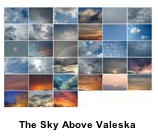
Inspired by Marc Kremers’ sky diary (see below), Valeska Oostrum has started her own, showing the skies above her home village of De Lier in The Netherlands (it is between Rotterdam and The Hague).
You can visit Valeska’s sky diary here.
Category: Attention All Cloudspotters
You can’t look around when you’re looking up, so we’ve had a look around for you.
If you have cloud news that you think we should include here, please email it to us at: [email protected].
September 7, 2006
September 7, 2006
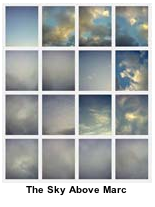
Marc Kremers, from London, kept a ‘sky diary’ last year. He used his camera phone to take a snap of the sky above him about four times a day over a period of several months. He wanted to see just how grey the skies over London really were, and to record how they changed with the seasons. The results of Marc’s sky diary are here:
http://tex-server.org/work/photographs/phone
/t610/theskyabovemarc/index.html
What a great idea. We’d love to see similar records of the skies above other cities of the world. If cloudspotters feel inspired to use camera phones to record their own sky diaries and they put them online as Marc has, we’ll add a link for others to see.
Send your sky diaries to:
[email protected]
September 7, 2006
No one could agree where they had formed and everyone claimed to have been the photographer. We decided to investigate…
September 7, 2006

The question of what music to listen to while gazing at the clouds has finally been solved. Nicolas Reeves, a professor at the University of Quebec in Montreal, Canada, has invented The Cloud Harp – an instrument that creates music from the shape of the clouds above it. So far, it has played in six cities around the world – Amos and Montreal (Canada), Lyon (France), Hamburg (Germany), Gizycko (Poland), and Pittsburgh (US).
When the sky is blue, the harp is silent, but with the first appearance of clouds above it, the music begins. “It uses a lidar,” explains Reeves, “which is a laser beam directed at the clouds. Whatever bounces back to the instrument is measured and gives us an idea of the brightness of the cloud, as well as its height.” A controller, known as a ‘cloudist’, configures the instrument so that this information triggers and controls particular musical sounds. He then leaves it to play the music of the clouds to passers by.
Sometimes musicians are brought in to provide orchestrations by recording the samples that the harp plays.“It means that we can play the clouds of St Louis, Missouri, through an arrangement by Helmut Finski of Montreal,” explains Reeves.
In Amos, in Northern Quebec, the Cloud Harp was installed in the clearing of a park, surrounded by trees. “When there was a full moon,” Reeves remembers, “people brought their sleeping bags and stayed the night next to the harp. They just lay there listening to the clouds – it was fantastic.”
See more about The Cloud Harp at
www.cloudharp.org.
September 7, 2006
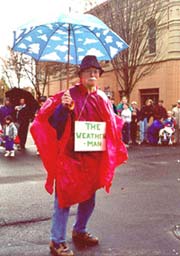 We were very excited to be contacted by the one and only John Day of Oregon, USA. He is commonly known as the Cloudman, as he has devoted his latter years to photographing, enthusing about and explaining the clouds. His website is full of fantastic images and information. We recommend it highly.
Indeed, eagle-eyed cloudspotters will notice that society founder, Gavin Pretor-Pinney, was filmed reading John Day’s book in the first of his short programmes about clouds and the Morning Glory. The fact that he fell asleep having read it should not be taken as evidence that it is anything other than a great book.
Visit John Day’s website:http://www.cloudman.com
September 7, 2006
 Soon-to-be-member, John Diefenbach, is based in Japan and has filmed the world’s last mainline steam trains, which operate in Inner Mongolia. Filming in mid-winter, with temperatures down to -30C, the steam effects, in some cases, are spectacular. We told him that we are cloudspotters, not train spotters, but it is fair to say that there is not much difference between what comes out of the train’s funnel and a time-lapse image of a cumulus cloud. Similar to the case of the UPS cloud stamps mentioned below, John’s films will be the ultimate for cloud enthusiasts who are also train nerds.
See John’s films at:
http://www.bachsitetoo.com
September 7, 2006
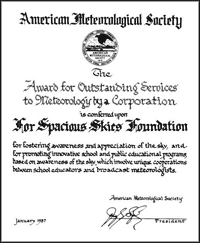 We were contacted recently by the venerable Jack Borden, Boston TV news reporter turned sky enthusiast. At the age of 45 he woke up from a nap in a nature preserve to see a sky he had never experience in all his previous life. “In a millisecond I saw more of the sky than in all my life to that point,” he says. He decided to quit his job and become a missionary of the sky. For Spacious Skies is the campaign he’s been running for twenty years or so to get school children and everyone else to pay more attention to what’s going on above us.
http://www.forspaciousskies.com/
September 7, 2006

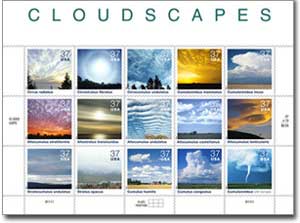 If you are a cloudspotter who collects stamps, prepare to have an orgasm. The US Postal Service has issued a set of stamps starring fifteen different types of cloud. All basic genera are featured except, that is, for the nimbostratus. But then it is a bit of a wet, wingey cloud, so we guess it’s fair enough.
July 17, 2006
There’s nothing quite as mesmerizing as watching time-lapse clouds.