
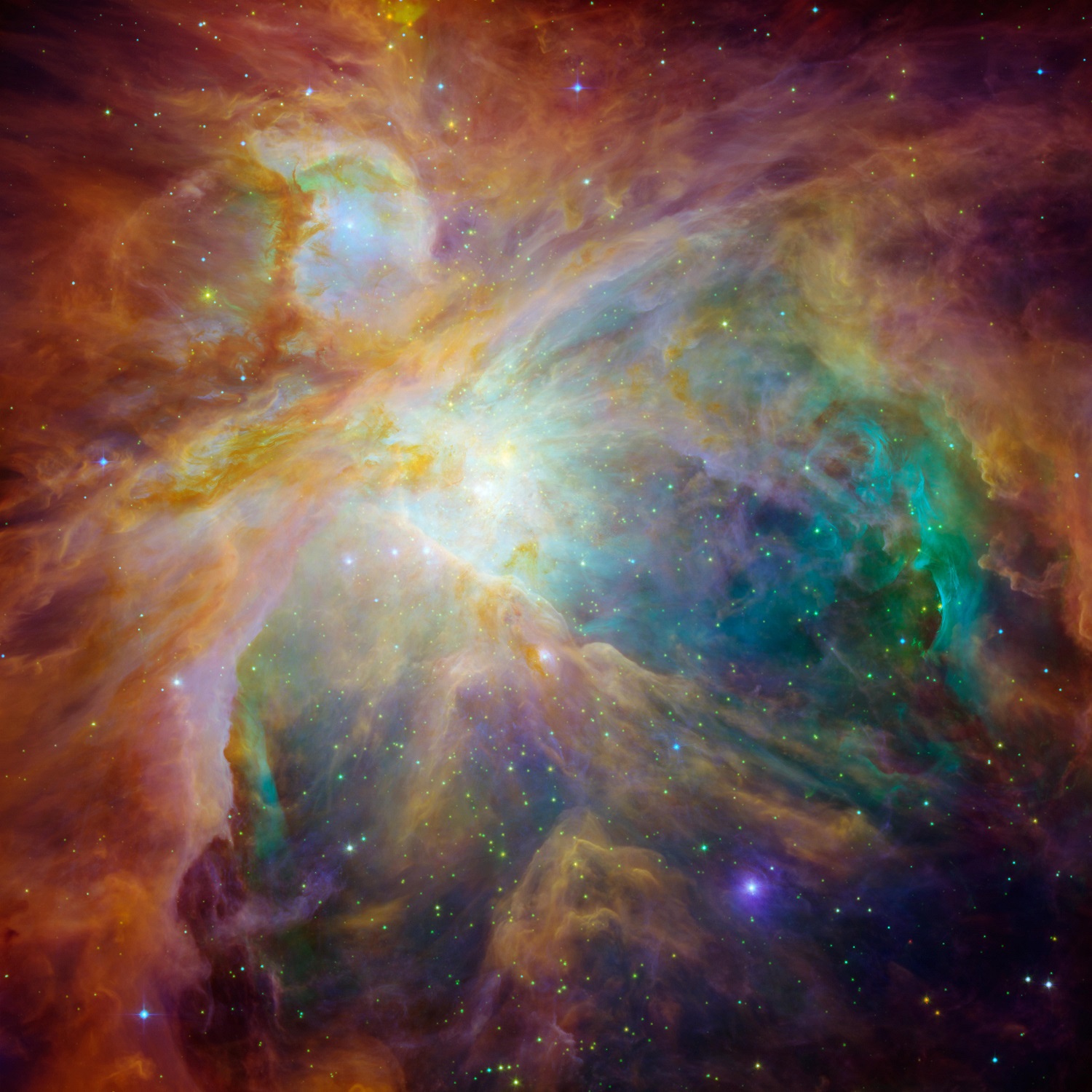
While Earth’s clouds breed rain, interstellar clouds give birth to stars. The Orion Nebula is one such deep-space cloud, located 1,500 light-years away in the constellation Orion, where it appears as the brightest spot in the sword hanging from the hunter’s belt. This vast stellar nursery is visible to the naked eye, lit from within by young stars, including the four massive stars known as the Trapezium.
The view here reveals the nebula’s complex structure in a composite image from the Hubble Space Telescope and the Spitzer Space Telescope. Hubble’s ultraviolet and visible-light observations show hydrogen and sulphur gas heated and ionised by intense starlight, while Spitzer’s infrared view reveals carbon-rich molecules known as polycyclic aromatic hydrocarbons. Together, they show the churning gas and dust of our nearest massive star-formation factory, where more than 1,000 young stars are currently taking shape.
Image Credit: NASA/JPL-Caltech STScI