

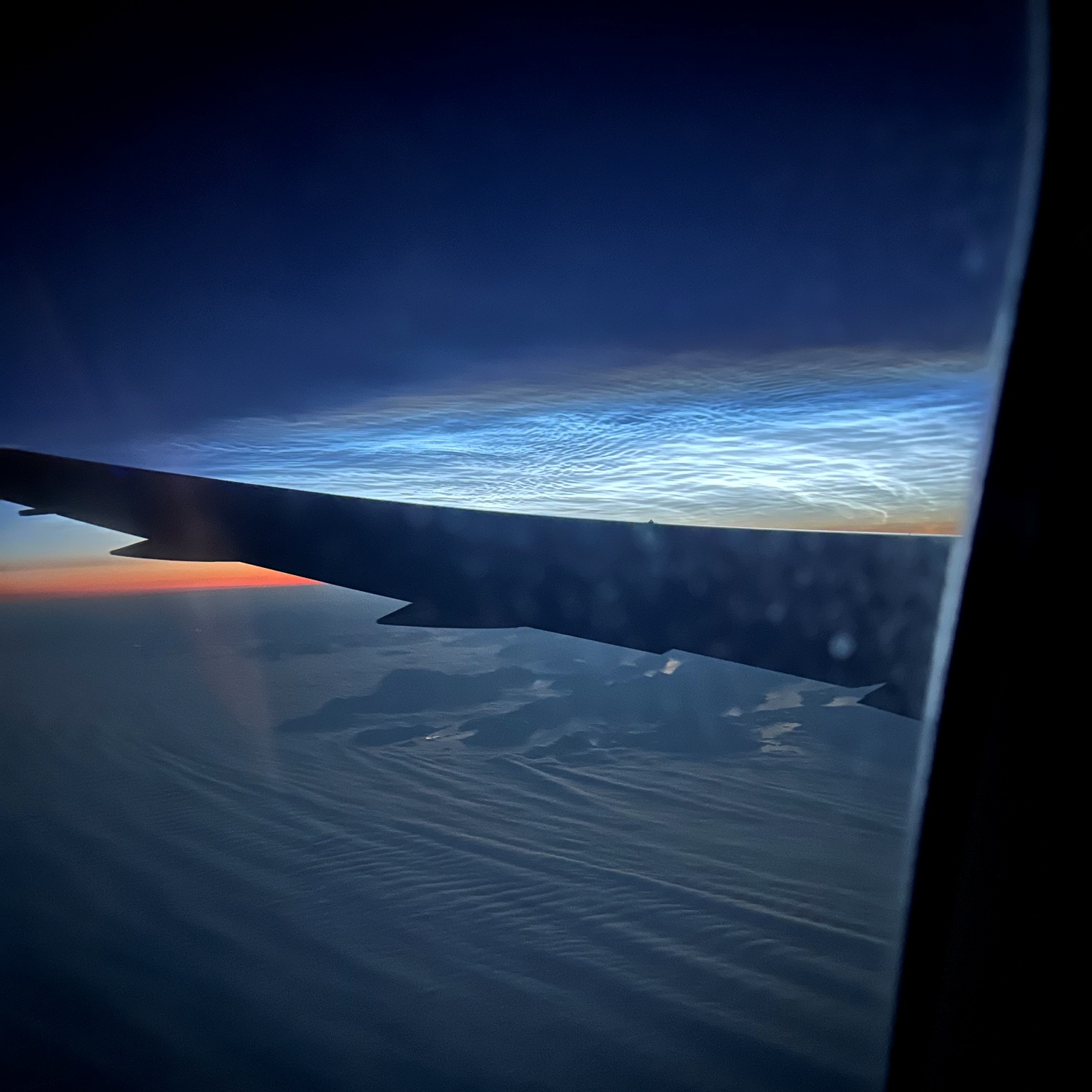
Sarah Kirn (Member 40,867) paid extra for a window seat on her flight from Boston, Massachusetts, US to Keflavík, Iceland in the hope of being able to spot a noctilucent cloud. Also known as polar mesospheric clouds, these form at altitudes of around 50 miles (85 km) – so high that they still catch the light when the Sun is way over the horizon, making them shine as eerie bluish ripples against the night sky. These formations tend to form during the summer months (of whichever hemisphere) when, counter intuitively, the mesosphere is coldest. As for Sarah’s wish, she ‘lucked out, big time’ with this view from her window of the clouds over southern Greenland.
Sarah’s interest in spotting the extreme-altitude formations was not just aesthetic; it was also scientific. That’s because Sarah works for NASA as a grantee, providing support to teams leading citizen science projects, where she has been involved recently with the Space Cloud Watch project. This is a NASA initiative to record observations of noctilucent clouds just before dawn and after dusk to analyse whether their viewing range has expanded in recent years. Historically, noctilucent clouds have been visible only at latitudes higher than 50 degrees, but scientists now think they are being spotted at lower latitudes because of changes to the upper atmosphere due to human activity like fossil fuel emissions and rocket launches.
If you would like to contribute to the Space Cloud Watch project, you can submit observations of noctilucent clouds at citsci.org/projects/space-cloud-watch/.