

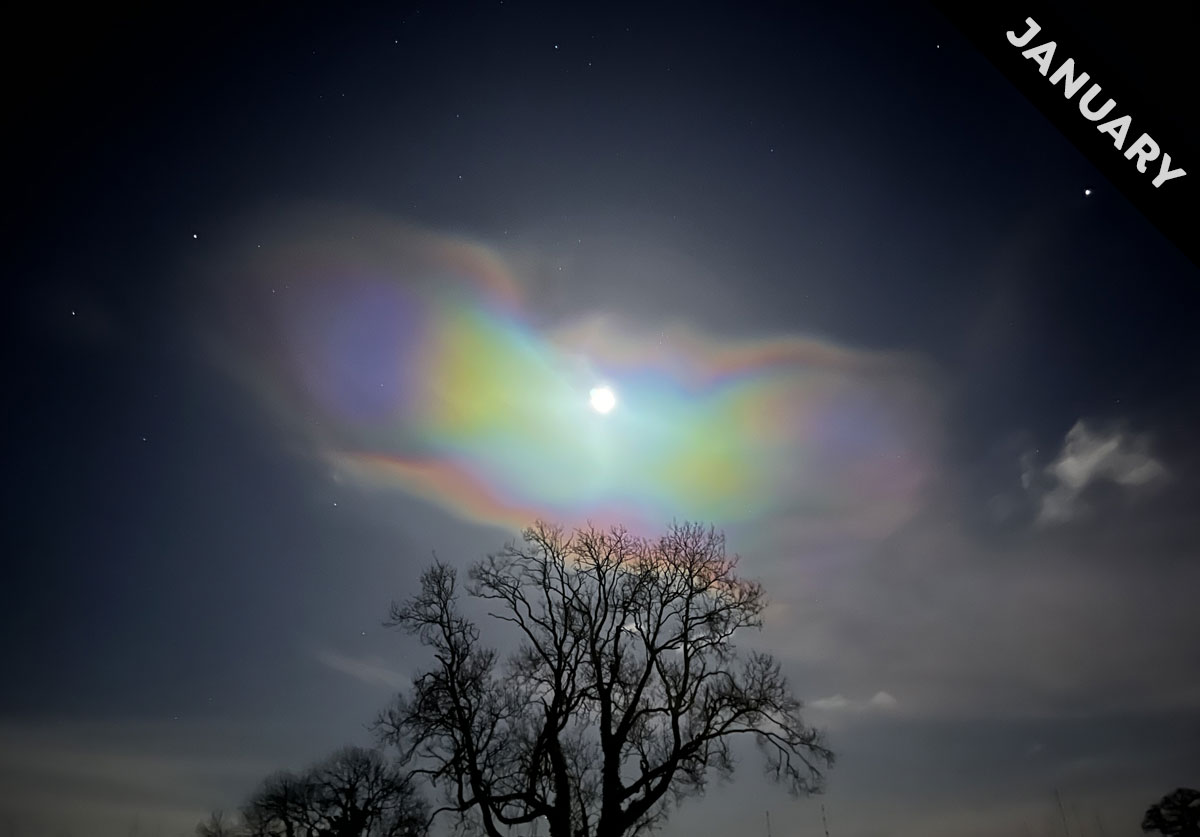
Nacreous Clouds – A Rare Nocturnal Display
Nacreous clouds have beautiful multicoloured mother-of-pearl colouration, and they form much higher than most other cloud types. They develop up in the stratosphere, at altitudes of between 15 and 25 km (9 and 16 miles), while most clouds form down in the troposphere, below about 10 km (6 miles).
Made of tiny ice crystals, nacreous clouds are rare formations, appearing only during the middle of winter and only when temperatures in the lower stratosphere fall as low as –85°C (–120°F). Such cold conditions are needed because there is very little moisture in the stratosphere to form the ice crystals, which is why you’ll need to be in higher-latitude regions of the world to be able to spot them. You’ll also typically need to be watching the sky during the twilight hours, just before sunrise or just after sunset.
That’s when the Sun is below the horizon but its light can still catch clouds right up in the stratosphere, illuminating them against the darkened sky. Very occasionally, they can appear further into the night when they happen to coincide with and overlap a full Moon. That’s what lit up these nacreous clouds spotted by Dan Raymond over Richmond, North Yorkshire, England. If nacreous clouds are rare, then seeing them in the middle of the night like this is even more so.
But what of the cloud’s signature colours? Its ice crystals are not only tiny – each just one hundredth of a millimetre across – they’re also very uniformly sized. This causes them to bend, or diffract, the light passing around them in a way that causes the light to be separated into regions of different hues. The wavelengths making up the light are bent by different degrees. This, and the way the waves overlap and interfere with each other, produces the cloud’s characteristic bands of pastel colours.
This same effect of diffraction and interference can cause iridescent hues to appear in tropospheric clouds, but they are never as vivid and intense as the mother-of-pearl colours formed by the minuscule, regularly sized ice crystals of nacreous clouds.
If you are fortunate enough to spot nacreous clouds during the twilight hours of dusk and you know that the Moon will be full or close to full, remember to take another look as night descends. The Moon might light the nacreous clouds again for a late night bonus display and make an already rare multicoloured cloudspotting experience rarer still.
Nacreous clouds lit by a full Moon and spotted over Richmond, North Yorkshire, England by Dan Raymond. View this in the photo gallery.


What a spectacular find!