
August 09 Cloud of the Month
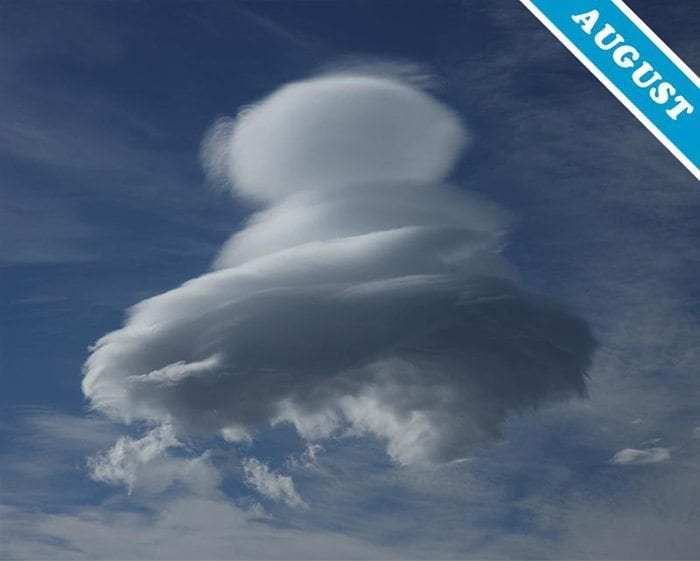
(Click image to enlarge) Photographed over El Chalten, Patagonia © John Maltas.
See this photo in the Cloud Gallery here.

August 09 Wiro

Your turn to do the washing up

The cloud species known as lenticularis is one of our favourite formations — not least because it often has the appearance of a UFO. The cloud’s name comes from the Latin for a ‘lentil’, presumably because no one could work out what the Roman’s would have called a flying saucer.

We like the way that this cloud hovers in place, even though a brisk wind is blowing at the cloud level. The cloud forms when the lower atmosphere is ‘stable’, which means that an airstream passing over raised ground, such as a hill or mountain, tends to rise and dip in a wavelike path. It is rather like the standing waves that hover on the surface of a fast-flowing stream in the lee of a rock. Lenticularis clouds can form downwind from the peak, at the crests of these invisible sanding waves of flowing air*.

But we particularly like it when lenticularis clouds take on the stacked formation, known as a ‘pile d’assiettes’, or ‘stack of plates’ in French, like the handsome Altocumulus lenticularis shown above. This type of stacked lenticularis only appears when the airstream encountering the raised ground consists of alternating moister and drier layers. The cloud droplets form as the moister layers cool upon rising at the crest of the standing wave, but are far less plentiful in the drier layers of air in between. Pile d’assiettes is the only internationally accepted cloud term that is in French rather than Latin.

* When the atmosphere in the region is particularly stable, even just a gentle raising of ground level can be enough set up the waves of air that produce lenticularis clouds.


Current Cloud of the Month:
March 2010

Previous Clouds of the Month:
February 2010
January 2010
Cloud Reflections (December 09)
Numbers in the Clouds (November 09)
Sun Pillar (October 09)
Convection Clouds (September 09)
‘Pile d’Assiettes’ (August 09)
Cumulus congestus (July 09)
‘Asperatus’ (June 09)
Clouds at Night (May 09)
Sundogs (April 09)
Diamond Dust (March 09)
Cloud Streets (February 09)
Crepuscular Rays (Jan 09)
Valley Fog (December 08)
Cloud Shadows (November 08)
Contrails (October 08)
Mamma (September 08)
Kármán Vortex (August 08)
The Summertime Halo (July 08)
The Nor’west Arch (June 08)
Microbursts (May 08)
Irridescent Clouds (April 08)
Northern Lights – Aurora Borealis (March 08)
Ice halos (February 08)
Lightning (January 08)
Roll Cloud (December 07)
Banner Cloud (November 07)
Stratocumulus (October 07)
The Unclassified Cloud (September 07)
Alexander’s Dark Band (August 07)
Fumulus Snail (July 07)
Distrail (June 07)
Altocumulus undulatus (May 07)
Cumulonimbus capillatus (April 07)
Lacunosus (March 07)
Horseshoe Vortex Cloud (February 07)
Jet-Stream Cirrus (Janurary 07)
Altostratus/Altocumulus/Altowhateveritis (December 06)
Anti-Crepuscular Rays (November 06)
Stratocumulus (October 06)
Altocumulus (September ’06)
The Kelvin-Helmholtz Wave Cloud (August ’06)
The ‘Brocken Spectre’ (July ’06)
‘Whale’s Mouth’ (June ’06)
Noctilucent (May ’06)
Cirrus (April ’06)
Cap Cloud (March ’06)
Fallstreak Holes (February ’06)
Nacreous (January ’06)
Cirrostratus (December ’05)
Tuba (November ’05)
Virga (October ’05)
Cirrocumulus (September ’05)
Altostratus (August ’05)
Cumulus (July ’05)
Mamma (June ’05)
Pileus (May ’05)
Lenticularis (April ’05)
Stratus (March ’05)
Cumulonimbus (February ’05)
Contrails (January ’05)


To contribute a Cloud of the Month,
go to our Photograph Submissions page.

Back to home page