
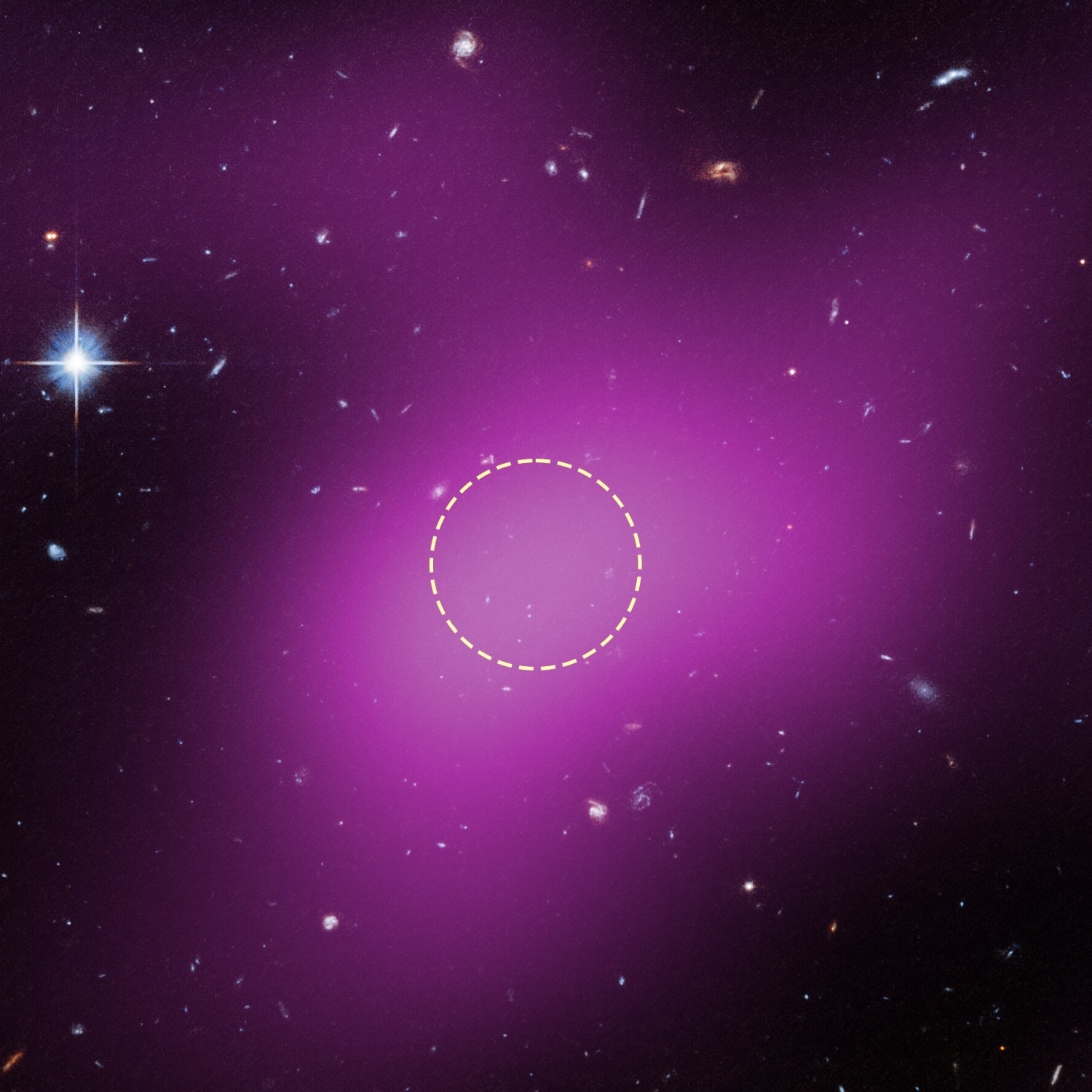
In January 2026, space scientists announced that they’d discovered Cloud-9. Well, that’s what they nicknamed it. The official name for what turned out to be a triumph of extraterrestrial cloudspotting is the Reionization-Limited H I Cloud, abbreviated to RELHIC. It is located 14 million light-years from Earth and is composed of hydrogen gas with a mass about a million times that of our Sun. But the special thing about Cloud-9 is not what is there; it’s what’s missing.
What can you see in the dotted circle at its middle? Nothing much. Back in 2023, the radio frequencies emitted from this object had led researchers to assume it was a dwarf galaxy. But close examination of the central region in 2025 by the Hubble Space Telescope revealed that the ‘galaxy’ lacked a key ingredient: stars.
Cloud-9’s smooth, empty gaseous appearance reveals the properties of dark matter in the absence of stars. (Those bright spots appearing in the cloud here are just galaxies far beyond.) As the first-discovered failed galaxy, this Cloud-9 offers a peek into the makeup of the early universe and an opportunity to study the physics of dark matter.
This Cloud-a-Day was suggested by Timothy Kessler (Member 45,331).
Image: NASA/ ESA/ G. Anand (STScI)/ and A. Benitez-Llambay (University of Milan-Bicocca). Image processing: J. DePasquale (STScI).