

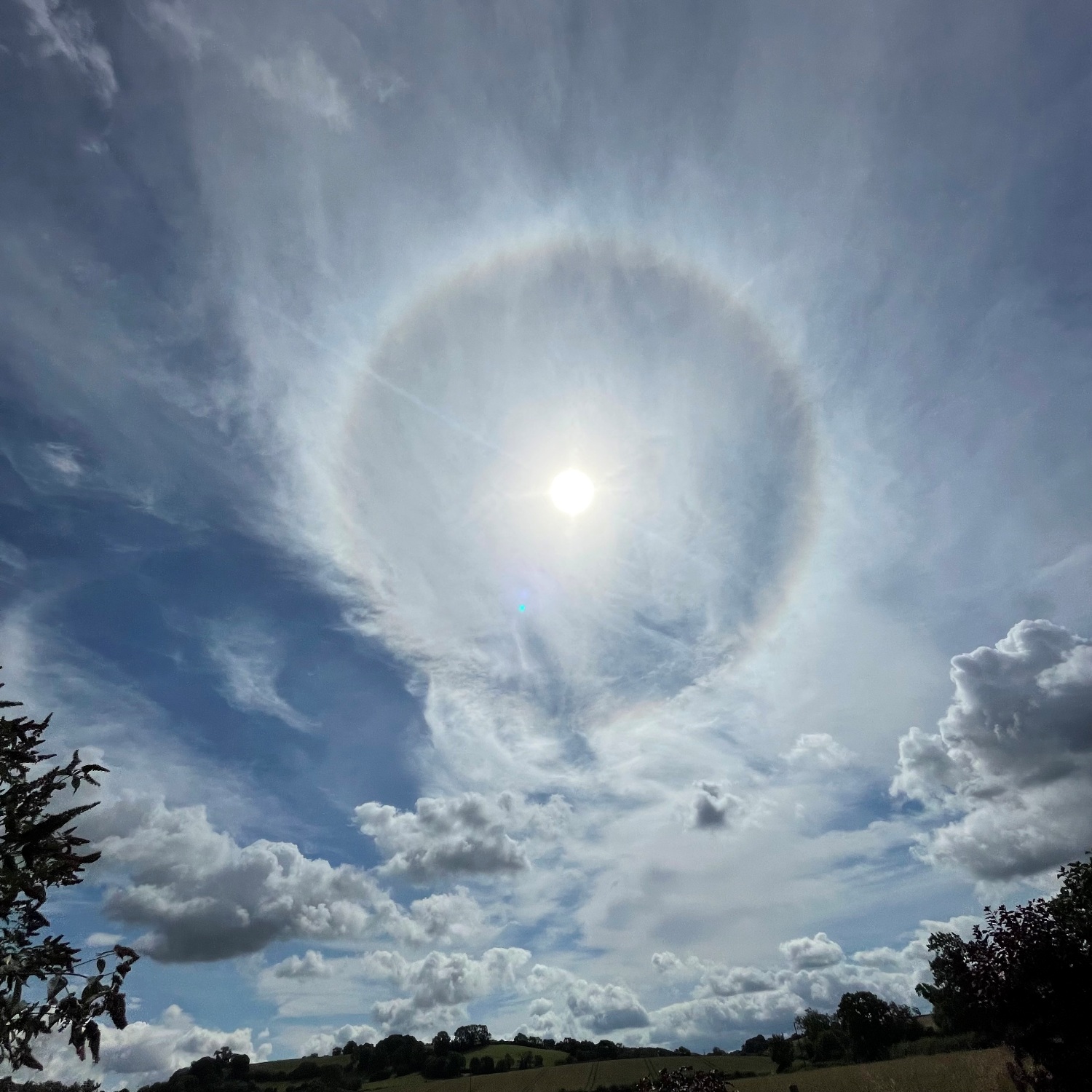
Around noon one August day, Irene Roberts (Member 61,357) was just taking the washing out in Tysoe, Warwickshire, England when she was stopped in her tracks by an enormous bright ring around the Sun, gleaming above the more everyday Cumulus clouds.
A 22-degree halo shows up when sunlight (or moonlight) passes through millions of tiny ice crystals suspended in the air, like the ones up in Irene’s Cirrostratus cloud. The crystals in this high-level layer of cloud must be clear enough and of regular enough shape to act like tiny prisms, bending the light as it enters one face and exits another. Because of the hexagonal symmetry of the crystals, most of the light gets bent, or refracted, by 22 degrees. As the crystals tumble through the sky, the next effect here is a ring of light round the Sun. Point one arm at any point on the ring and the other at the Sun in the middle, and your arms will be at an angle of 22 degrees. The inner edge of the halo can appear red, as this wavelength of light is refracted less strongly, while the part of the sky between the Sun and the ring itself is darker, as none of the light passing through the crystals is refracted at these smaller angles.
‘I stood in awe for quite a while, till the halo faded,’ Irene told us. ‘Turned out to be a great wash day after all!’