
Frederic Church Week: Sunday
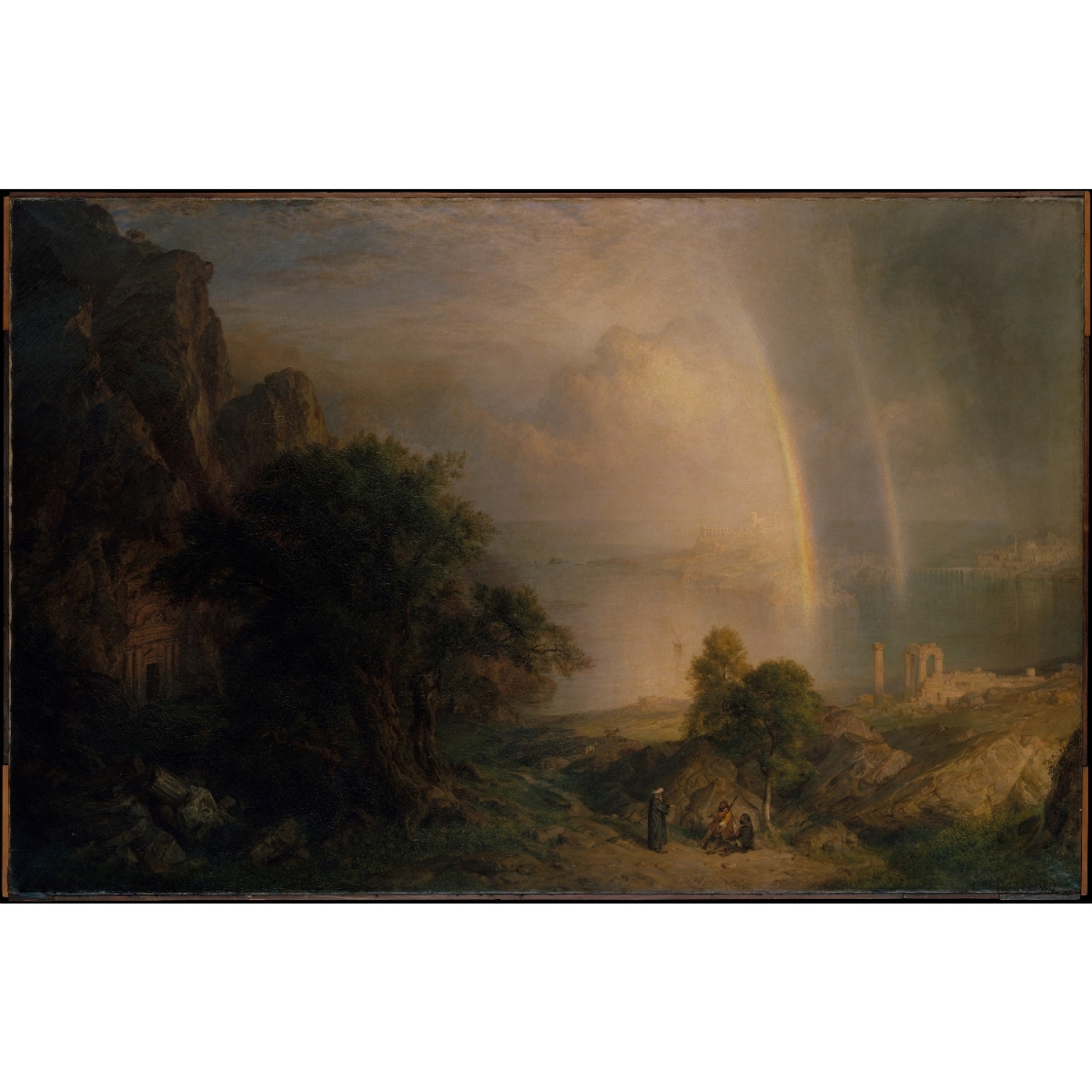
‘I am appalled,’ Frederic Church once wrote to the America art critic Henry Tuckerman, ‘when I look at the magnificent scenery which encircles my clumsy studio, and then glance at the painted oil-cloth on my easel.’ Church produced The Aegean Sea in 1877. It was one of his last large-scale oil paintings. Though the title suggests Greece, this is a composite or imagined landscape, assembled from sketches and photographs he had made during his travels in West Asia and Europe in the 1860s. In the luminous scene, arching through the misty light, Church included a pair of rainbows that the artist deserved to be proud of.
Church depicted a brighter primary rainbow inside a dimmer secondary rainbow. The primary bow, being made of sunlight reflected once off the inside backs of raindrops, is always brighter than the secondary, which is made of light that reflected twice in the drops. Church also correctly showed how the order of the colours in the primary and secondary bows are reversed. And the shadows of the figures he painted in the foreground correctly point towards the middle of the bows, just as they would in real life.
In describing Frederic Church’s work, Henry Tuckerman wrote, ‘The sky was the field of his earliest triumphs; some of its most remarkable and least delineated phases in the western hemisphere, he boldly and truly transferred to canvas. Few artists have so profoundly and habitually studied sunshine and atmosphere.’
Frederic Edwin Church, The Aegean Sea, c. 1877, oil on canvas, 54 in. × 84 1/4 in. (137.2 × 214 cm), The Metropolitan Museum of Art, Bequest of Mrs. William H. Osborn, 1902, 02.23. The quotations are from Book of the Artists: American Artist Life (1867) by Henry T Tuckerman.