
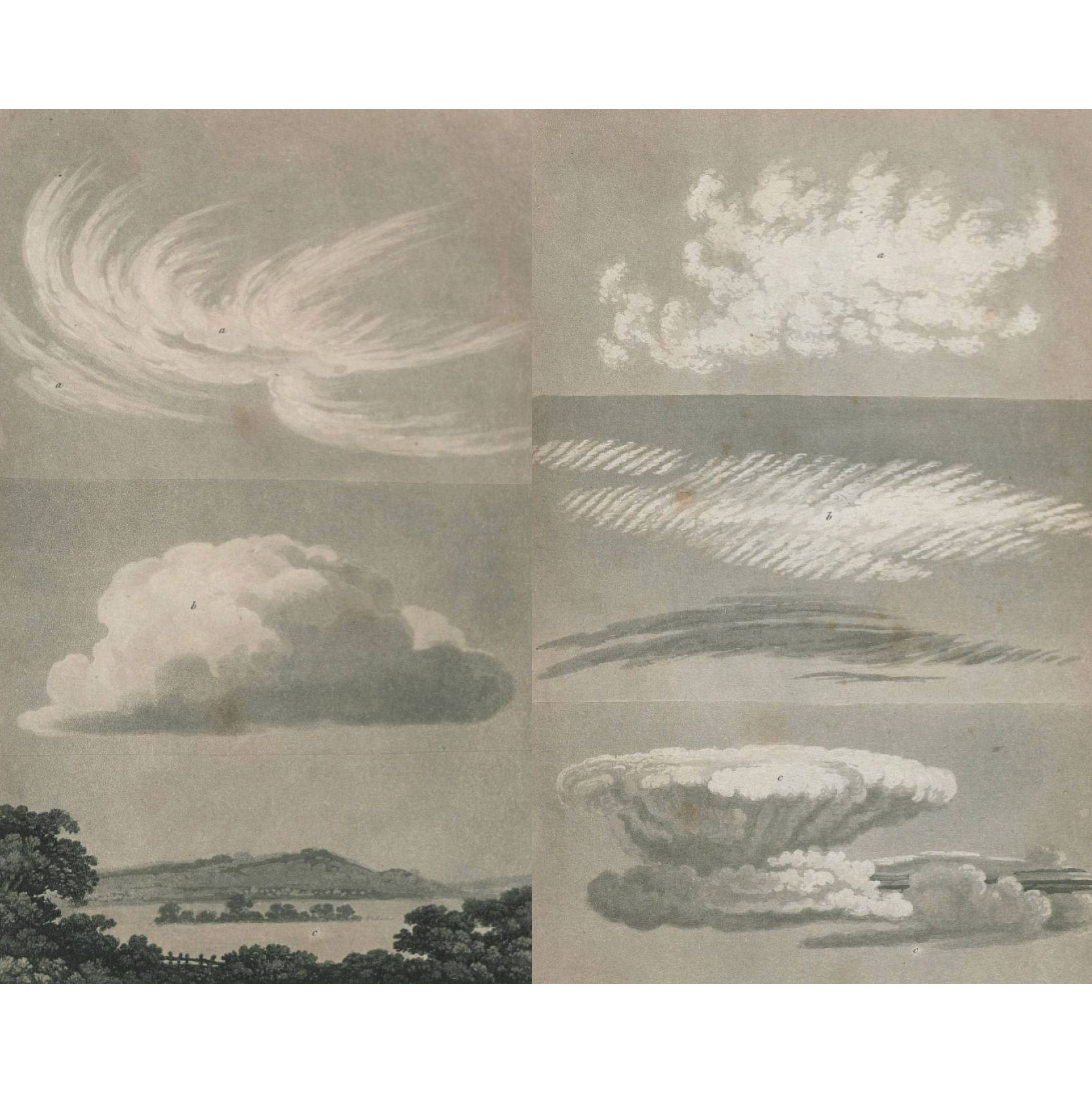
In 1802, an English pharmacist and sky enthusiast called Luke Howard proposed a naming system for clouds at his local scientific debating society. His idea would earn him the title ‘The Father of Meteorology’. Clouds, he argued, obey the laws of physics rather than drifting as random shapes. Borrowing from Latin, as in the naming of plants and animals, he called towering heaps ‘Cumulus’, wispy streaks ‘Cirrus’, and layered sheets ‘Stratus’. Because clouds are so changeable, he referred to his terms as ‘modifications’ rather than classifications, and he allowed terms to be combined – such as ‘Stratocumulus’ for a clumpy layer. He used ‘Nimbus’ for rain clouds.
Published in 1803 in Philosophical Magazine, his system spread across the Western world. Scientists, artists, and poets embraced this new language of the sky, and it remains the foundation of cloud classification today. Yet Howard’s former home in Tottenham, North London now stands semi-derelict. A small blue plaque on its wall is the only hint of its significance: ‘Luke Howard (1772-1864), Namer of Clouds, lived and died here’.
Illustrations of Luke Howard’s cloud types from his 1803 article ‘On the Modification of Clouds’. Left, top to bottom: Cirrus, Cumulus, and Stratus. Right, top to bottom: Cirrocumulus, Cirrostratus, and Cumulostratus. All these names remain in use today except the last, which has been modified to Cumulonimbus.