

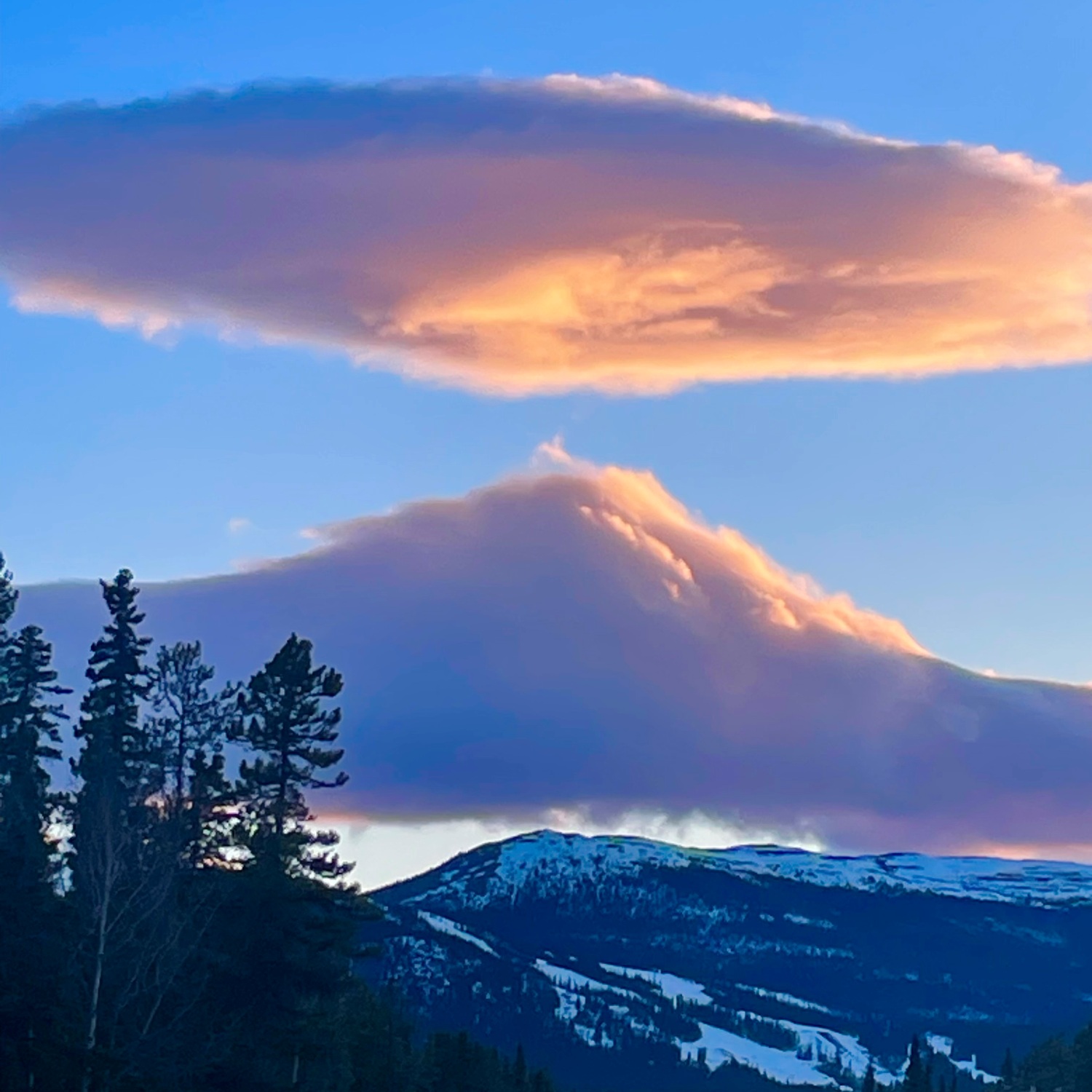
Aileen, a friend of Michael Fabijan (Member 64,211), spotted this pair of lenticularis clouds over Whitehorse, Yukon, Canada, where one was shaped like a spacecraft hovering above the other that was in the shape of a mountain.
The real mountains below were responsible for shaping these lenticularis clouds. They cause the winds to rise and dip as they flow over them, with the lenticularis clouds forming where the air cools most at the crests of these invisible standing waves of flowing air. Their name comes from the Latin for ‘a lentil’ because these mountain wave clouds tend to be disc shaped. The higher one that Aileen spotted, which we would call an Altocumulus lenticularis, certainly does have the characteristic flying-saucer shape. But what about the lower one that is itself shaped like a mountain?
This lower one would be called a Stratocumulus lenticularis, and it demonstrates that being shaped like a lens or a lentil isn’t the only factor in classifying a cloud as a lenticularis. This cloud’s smooth, laminar appearance is also a factor, as is its location in the vicinity of raised terrain like the mountains of the southern Yukon. The lower flow of air forming the Stratocumulus lenticularis must have been moist enough for cloud to form over an extended region of rising and dipping air. It rose in a peak of cloud downwind of the same mountain peak that caused the flying-saucer Altocumulus lenticularis above. Cloud classification can sometimes be a blurry matter based on the cloud’s appearance, its altitude, and its likely method of formation.