

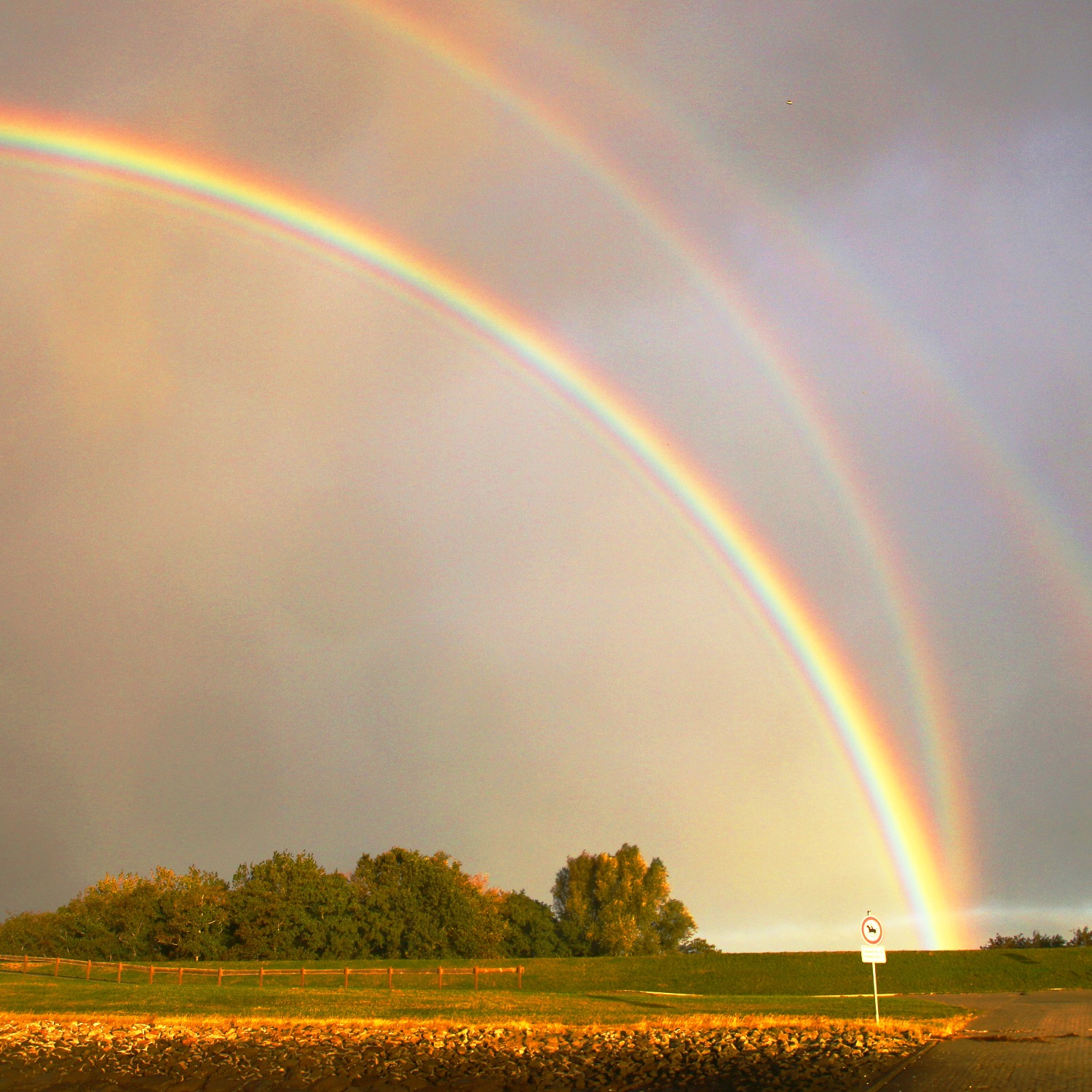
Peter Ebert (Member 42,807) ventured out on the small island of Neuwerk, Germany to photograph the Sun rising over the mudflats. As it appeared above the eastern horizon, Peter felt a few raindrops and looked around to see a trio – no, wait, a quartet – of rainbows in the sunlit shower behind him.
The concentric bows reaching down on either side of the paved causeway are the common ones: a primary rainbow, brighter on the left, and a secondary rainbow, dimmer on the right. They appear as direct sunlight shines through raindrops and reflects off their inside back surfaces – once for the primary bow and in two places for the secondary one. But what about the rainbow at an odd angle between them and the really faint one at the same angle just discernible to the right of the secondary bow? For these, Peter could thank the flooded mudflats between him and the Sun now shining on his back.
These were rare reflection rainbows. They can appear when sunlight shines onto a rain shower not directly but after reflecting up from a body of water behind the viewer – like those flooded mudflats. This sunlight is shining onto the shower from a different angle, as if from a Sun below the horizon rather than above it, and so the reflection rainbow equivalents of the primary and secondary bows appear at a completely different angle. Even so, the laws of optics decree that any rainbow will always, like Peter’s, meet its reflection-rainbow cousin at the horizon.