

Filter By:
Main Cloud Types
- Cumulus
- Stratus
- Stratocumulus
- Altocumulus
- Altostratus
- Cirrus
- Cirrocumulus
- Cirrostratus
- Nimbostratus
- Cumulonimbus
Other Clouds
- Arcus
- Asperitas
- Cap / banner clouds
- Capillatus
- Castellanus
- Cataractagenitus
- Cauda (Tail cloud)
- Cavum (Fallstreak hole)
- Congestus
- Contrail (homogenitus)
- Duplicatus
- Diamond dust
- Distrail
- Fibratus
- Flammagenitus (Pyrocumulus)
- Floccus
- Fluctus (Kelvin-Helmholtz)
- Fractus
- Homogenitus
- Horseshoe vortex
- Humilis
- Incus
- Intortus
- Lacunosus
- Lenticularis
- Mamma
- Morning Glory Cloud
- Murus (Wall cloud)
- Mediocris
- Nacreous
- Nebulosus
- Noctilucent
- Pannus
- Perlucidus
- Pileus
- Praecipitatio
- Radiatus
- Silvagenitus
- Spissatus
- Stratiformis
- 'Supercilium' (not official classification)
- Translucidus
- Tuba / Twister
- Uncinus
- Undulatus
- Velum
- Vertebratus
- Virga
- Volutus (Roll cloud)
Optical Effects
- 22° Halo
- 46° Halo
- Circumhorizon Arc
- Circumscribed halo
- Circumzenithal Arc
- Cloudbow / Fogbow
- Corona
- Crepuscular rays & shadows
- Diffuse arcs
- Green flash
- Glory
- Halos
- Helic arc
- Infralateral arc
- Iridescence
- Lower Sun Pillar
- Lower Tangent Arc
- Moonbow
- Moondogs
- Parhelic circle
- Parry antisolar arcs
- Parry arc
- Parry infralateral arc
- Parry supralateral arc
- Rainbow
- Sub parhelion
- Sub-sun
- Suncave parry arc
- Sun dog (Parhelion)
- Sun pillar
- Supernumerary bows
- Subparhelic circle
- Supralateral arc
- Upper tangent arc
- Wegener arc
August 4, 2006
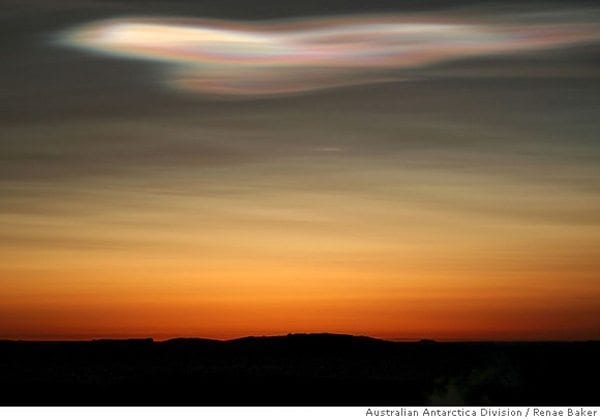
Some of the coldest temperatures on Earth brought a rare cloud formation to the skies over Antarctica on July 25, 2006. Meteorological officer Renae Baker captured spectacular images of the nacreous clouds, also known as polar stratospheric clouds, at Australia’s Mawson station in Antarctica. The clouds only occur at high polar latitudes in winter, requiring […]
[social_share]
One thought on “Some of the coldest temperatures on Earth brought a rare cloud formation to the skies over Antarctica on July 25, 2006. Meteorological officer Renae Baker captured spectacular images of the nacreous clouds, also known as polar stratospheric clouds, at Australia’s Mawson station in Antarctica. The clouds only occur at high polar latitudes in winter, requiring temperatures less than minus 176 degrees Fahrenheit. A weather balloon measured temperatures at minus 189 degrees Fahrenheit on the day the photos were taken.”
Leave a Reply Cancel reply
You must be logged in to post a comment.
This site uses Akismet to reduce spam. Learn how your comment data is processed.
August 4, 2006
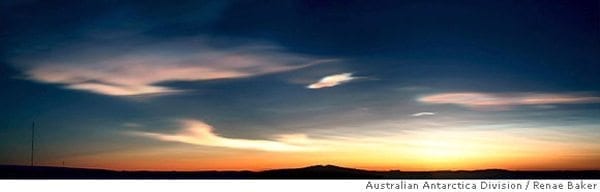
Some of the coldest temperatures on Earth brought a rare cloud formation to the skies over Antarctica on July 25, 2006. Meteorological officer Renae Baker captured spectacular images of the nacreous clouds, also known as polar stratospheric clouds, at Australia’s Mawson station in Antarctica. The clouds only occur at high polar latitudes in winter, requiring […]
[social_share]
Leave a Reply Cancel reply
You must be logged in to post a comment.
This site uses Akismet to reduce spam. Learn how your comment data is processed.


Thankyou Renae, these shots of the Antartic are difficult to get by the average snapper!