
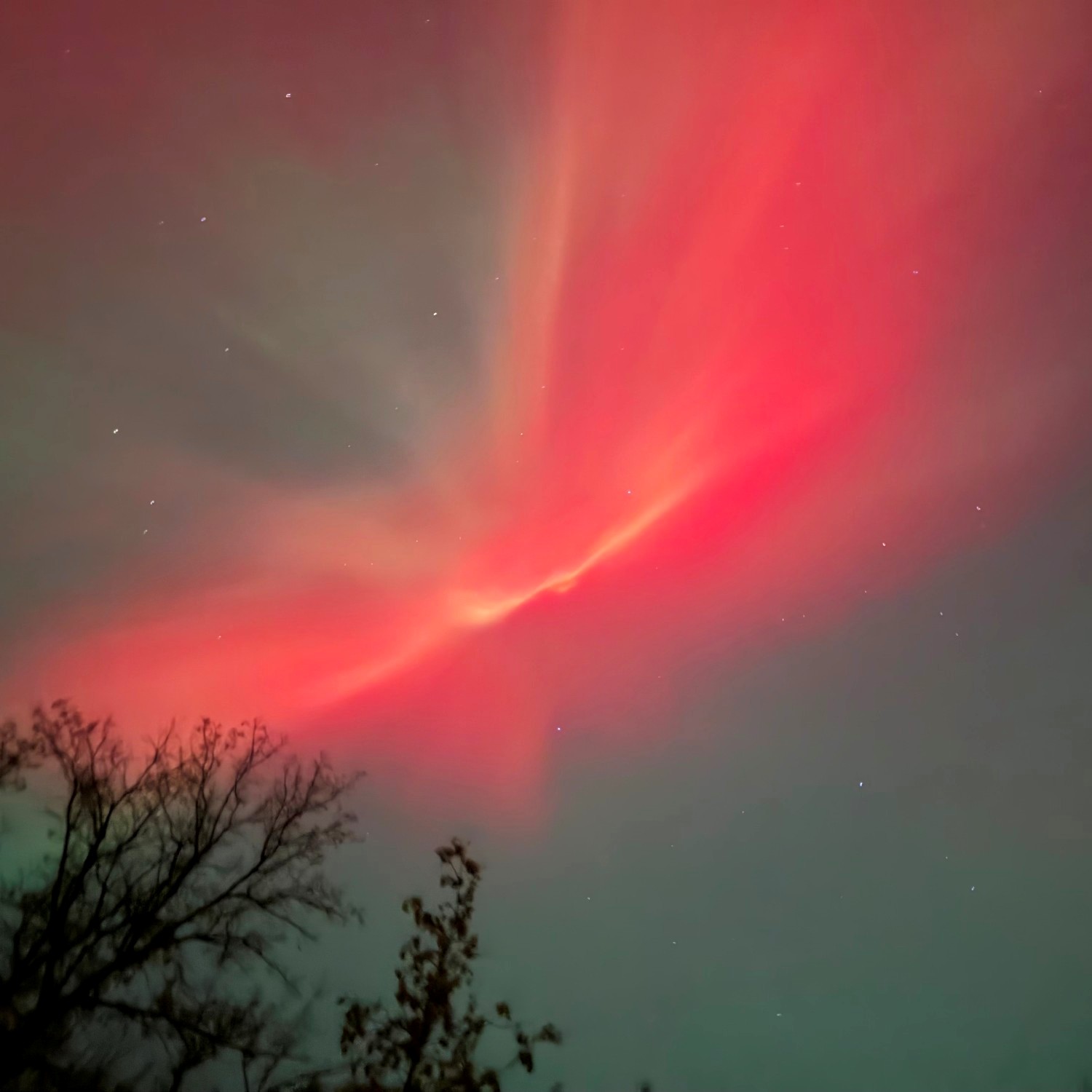
In early November, many people in the contiguous US saw colours in the night sky as charged particles from the Sun caused a severe geomagnetic storm in Earth’s magnetosphere, from where they were flung down at high speeds into our upper atmosphere. Over Prior Lake, Minnesota, US, Perri Franskoviak (Member 58,895) saw the aurora borealis that resulted, which appeared for a brief moment like a bow tie. The colours and shapes of the aurora depend on the severity of the solar storm, the gases in the upper atmosphere that the charged particles excite, and the altitudes where the interactions occur.
When the display appears to radiate out from point, like Perri’s did, it is known as an auroral corona. The streaks of light may appear to emanate from a point, but they don’t actually touch at all. The effect is just another of the sky’s many tricks of perspective. Like the fanned appearance of parallel shafts of light and cloud shadows that are known as crepuscular rays, this corona appearance of aurora results from streams of incoming charged particles that are as good as parallel. Peering up the length of them like Perri did is to gaze up a sweeping vertical tunnel of light that stretches to the upper reaches of our sky.