
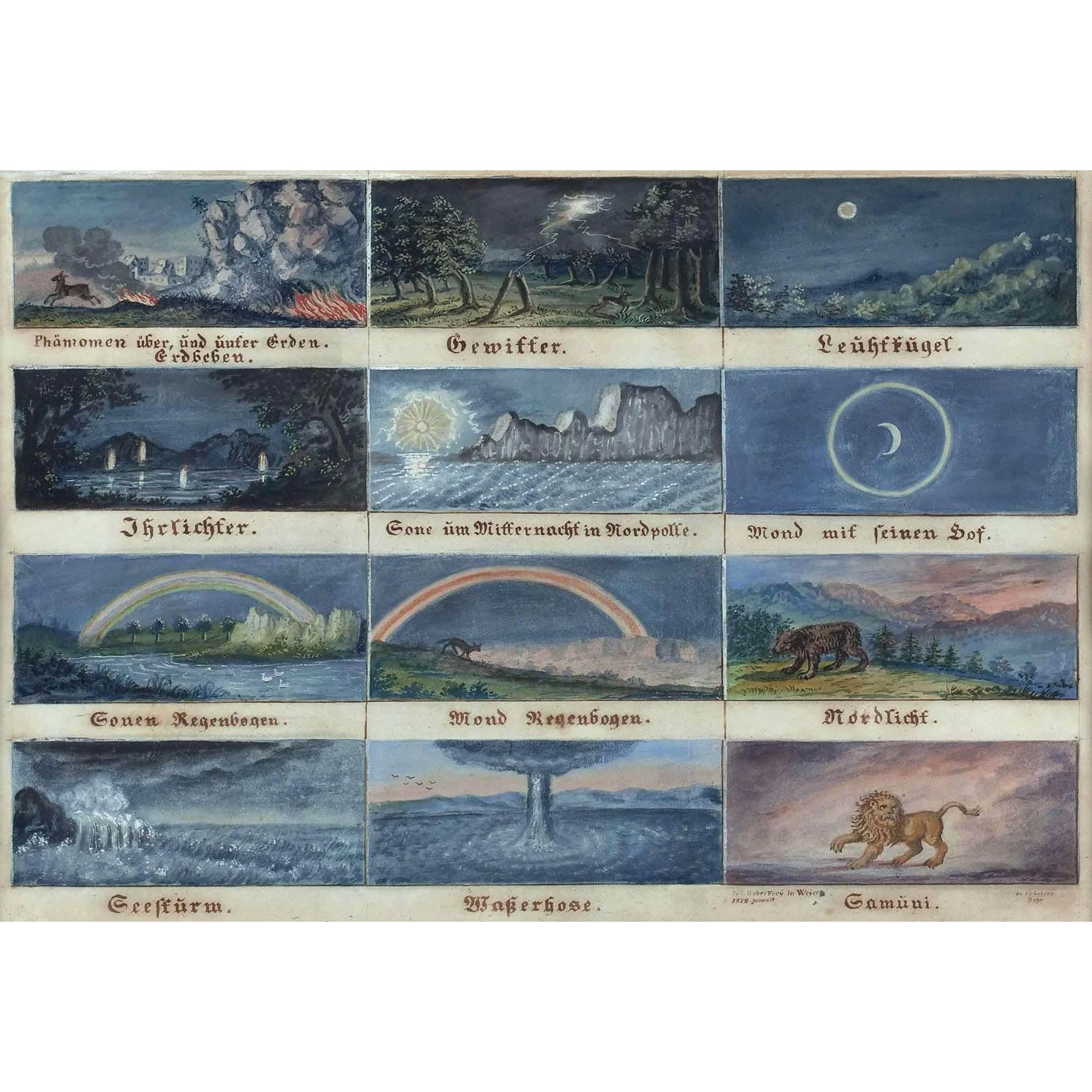
Josef Gabriel Frey was a nineteenth-century leatherworker and self-taught artist from Weyer, Austria who seems to have painted not for artistic ambition but simply as a way of recording the world around him. In 1878, he created 12 Ansichten von atmosphärischen Phänomenen (Twelve Views of Atmospheric Phenomena). The work depicts natural events, one of which is an earthquake (Erdbeben), while the rest are atmospheric. Frey chronicled a thunderstorm (Gewitter), ball lightning (Leuchtkugel), will-o’-the-wisps (Irrlichter), the midnight sun near the Poles (Sone um Mitternacht im Nordpolle), a 22-degree lunar halo (Mond mit seinen Hof), both solar and lunar rainbows (Sonnen Regenbogen and Mond Regenbogen), the aurora borealis, or Northern Lights (Nordlicht), a sea storm (Seesturm), a waterspout (Wasserhose), and a ‘simoom’ desert dust storm (Samüri).
Frey created this cabinet of atmospheric curiosities late in life, when he was 88 years old. Some of the phenomena like thunderstorms, rainbows and halos he had likely witnessed directly. Others like the midnight sun and desert dust storms he may only have known from reading. Frey’s diaries suggest he was meticulous in his observations. He chronicled detailed daily weather notes, and he used drawing and painting to record weather phenomena he considered noteworthy.