

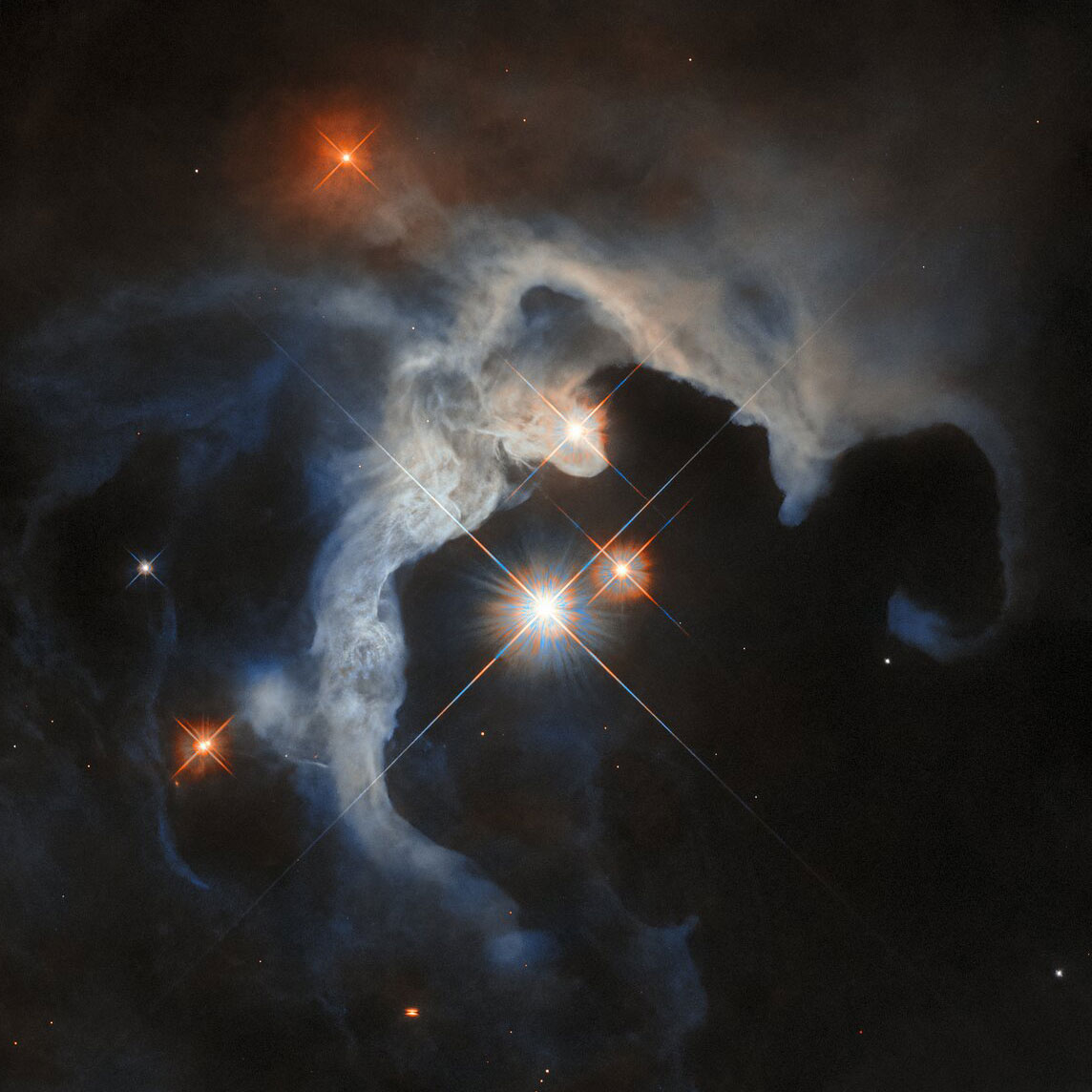
When we say that stars are ‘young’, we mean they’re _comparatively _young. Our Sun is around 4.6 billion years old, but HP Tau, the uppermost of the three stars blazing in the middle of this image from the Hubble Space Telescope, is but a sprightly 10 million years old. This is a T Tauri star, which means that it is so young that it has not even begun nuclear fusion yet. Aw, sweet. Nonetheless, it is showing signs of growing up into a hydrogen-fuelled star just like our own Sun. This young whippersnapper of a future sun is twinkling alongside two other stars appearing beneath it, known as HP Tau G2 and HP Tau G3.
The trio are nestled in the hollowed cavity of a reflection nebula, which HP Tau is overlapping. Part of the stellar nursery known as the Taurus Molecular Cloud, this nebula is a cloud of interstellar gas and dust that’s visible to us because it reflects the light of nearby stars. Earth’s clouds of water droplets and ice crystals are visible for the same reason. Terrestrial cloudspotting is to admire ephemeral entities that can change and dissipate in a matter of minutes. Deep-space cloudspotting requires us to consider cloudscapes formed long before our time and that will outlive us all by millions of years.
Triple-star system comprising the variable star HP Tau, HP Tau G2, and HP Tau G3, spotted by NASA’s Hubble Space Telescope. (ESA/Hubble & NASA, G. Duchêne.)