

Frederic Church Week: Thursday
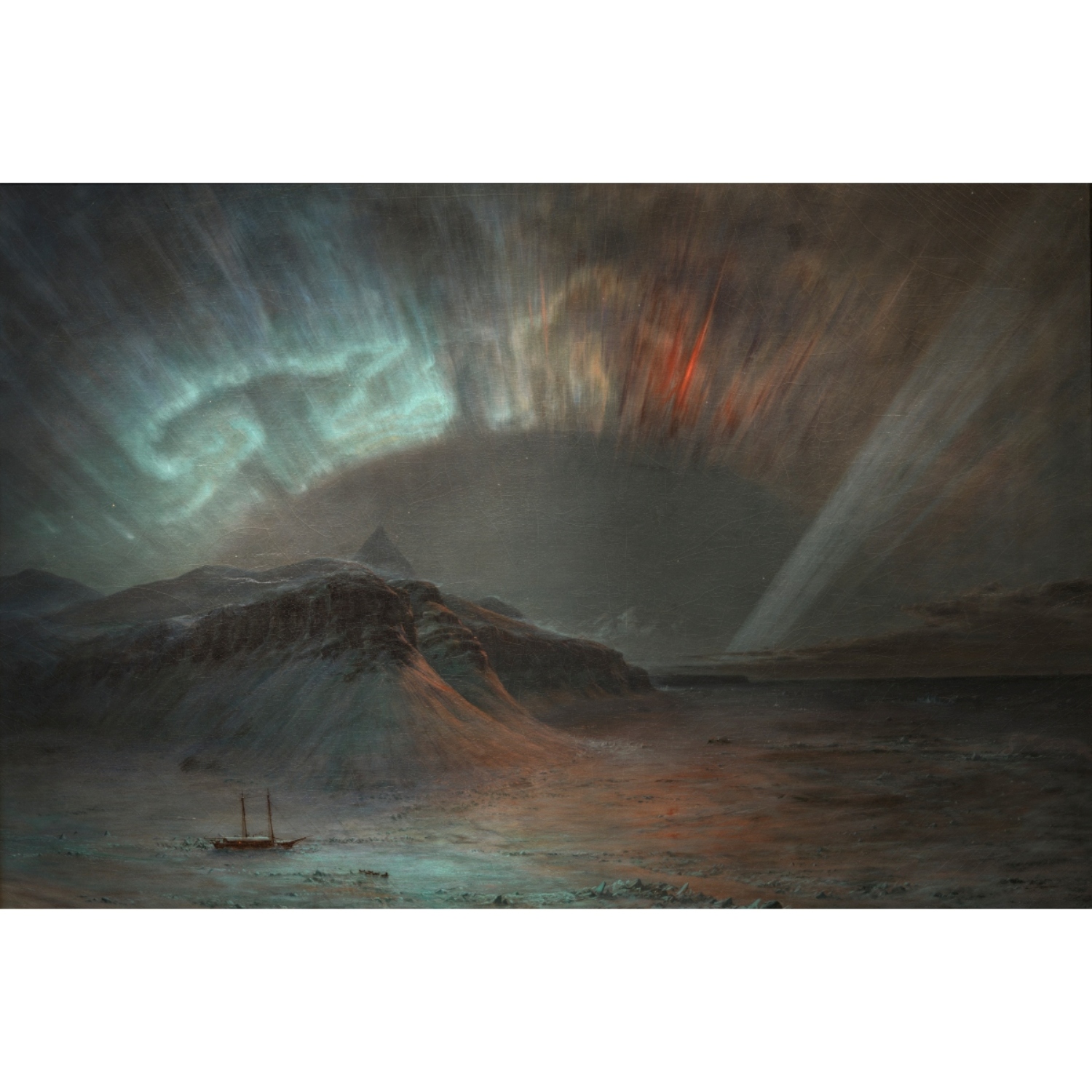
Frederic Church travelled far north in 1859, to Newfoundland and Labrador, to study icebergs, sea ice, and Arctic light firsthand. His interest in the region had been piqued by stories of the Arctic by explorer Isaac Hayes, who he ended up befriending. _Aurora Borealis _(1865) is Church’s interpretation of one of Hayes’s sketches from his Arctic expedition of 1860-1861. The aurora display happened while the expedition were trying to reach the North Pole and prove the existence of an ice-free, open polar sea. Hayes’s ship froze into the winter ice pack, which Church depicted in the lower left of the painting, after which the expedition party’s dog sledders set out across the ice pack, shown just to the lower right of the vessel.
Church seems to have painted two distinct types of polar light effect here. He depicted the aurora of the painting’s title as swirling curtains of green and red light extending in vertical streaks. But there is also a rather different pillar of paler light off to the right that appears to extend down to the horizon. Could this be the rare aurora-like glow known as a Strong Thermal Emission Velocity Enhancement, or STEVE?
Appearing during geomagnetic storms, STEVE is a narrow ribbon of light alongside the aurora that can extend for hundreds or thousands of kilometres, aligned east to west. In a classic example of citizen science, the phenomenon was first classified in 2016 after the Alberta Aurora Chasers enthusiast group in Canada brought their observations of it to the attention of aurora scientists at the University of Calgary and NASA. No one knew what to call this rare aurora-related phenomenon, so one of the aurora watchers, Chris Ratzlaff (Member 59,736), suggested they call it ‘Steve’ in reference to the movie Over the Hedge. Its scientific name was later coined as a ‘backronym’ to match the letters. Could the explorer Isaac Hayes, with the artistic help of Frederic Church, have been the earliest citizen scientist on the STEVE project?
Frederic Edwin Church, Aurora Borealis, 1865, oil on canvas, 56x 83 1⁄2 in. (142.3 x 212.2 cm), Smithsonian American Art Museum, Gift of Eleanor Blodgett, 1911.4.1.