

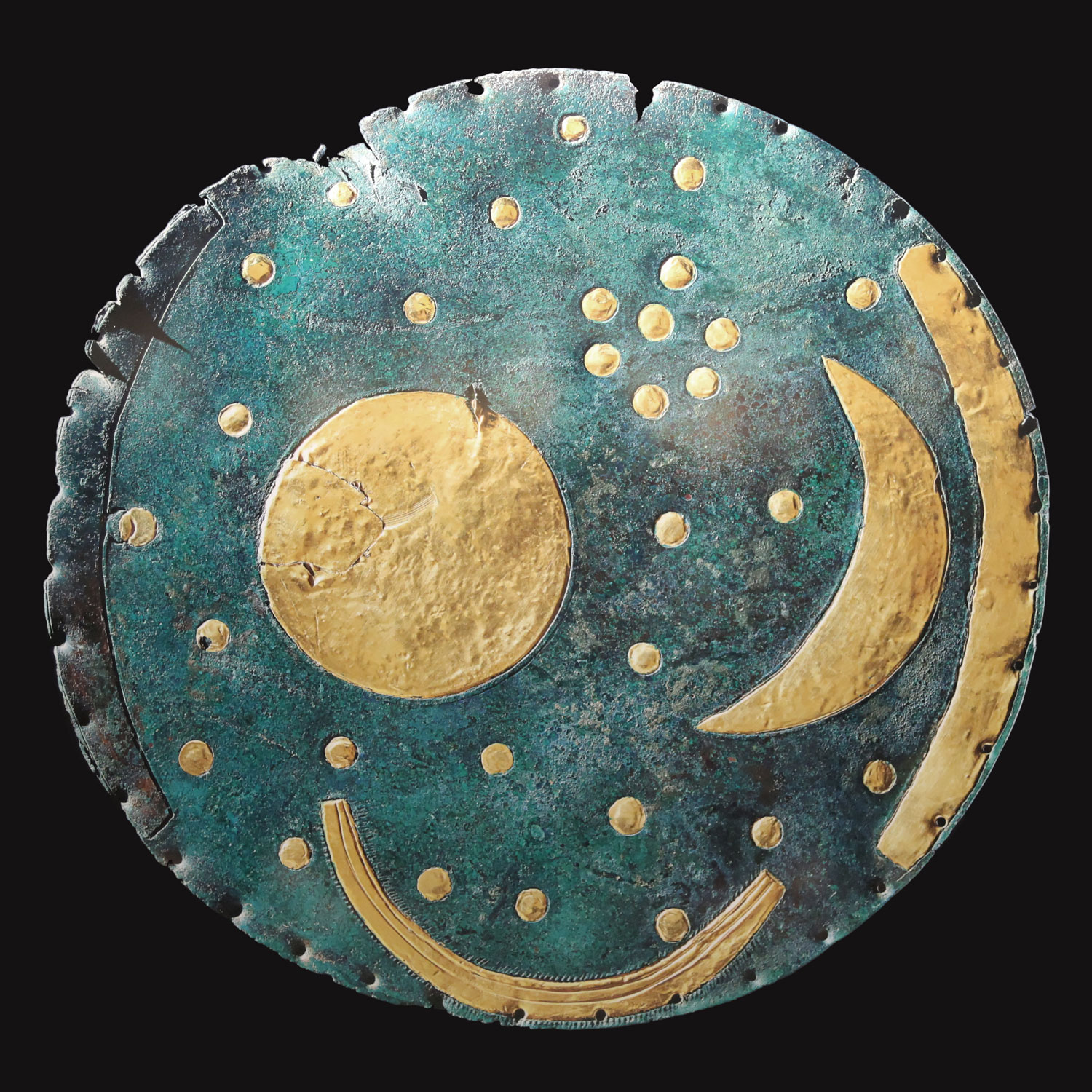
This bronze and gold circular object, known as the Nebra sky disc, was unearthed in 1999 on a hilltop near the town of Nebra in Germany. Dated to the Early Bronze Age, roughly between 1800 and 1600BCE, the disc is inlaid with gold shapes representing of stars – including a cluster of seven which may be the Pleiades – a crescent Moon, what’s likely the Sun, and three broad arches, one of which has been lost. At over 3,600 years old, the disc is the oldest-known physical depiction of astronomical phenomena in the world. Measuring about 30 cm (12 inches) across, it is likely to have been used as a kind of astronomical calendar to help plan agricultural events such as when to sow and to harvest. And it may have held religious significance.
The two gold arches at opposite sides of the disc (the left of which is now missing) were arranged relative to the stars to mark exactly the directions of the rising and setting Sun as they traversed the horizon between the winter and summer solstices. Facing north, with the disc held out horizontally like a plate in the orientation shown here, the Sun rises and sets in the directions of the near ends of the side arches in midwinter and the far ends in midsummer. And as for the more strongly curved arch scored with lines in the lower part of the disc? Some say it’s a representation of the solar boat, a mythical vessel common to many ancient cultures that carries the Sun across the sky. Others suggest it’s a comet, the aurora borealis, or a rainbow. The latter, being cloud related, is our choice.
The Nebra sky disc spotted by Frank Vincentz, in the collection of the State Museum of Prehistory in Halle, Saxony-Anhalt, Germany.
Frank Vincentz (CC BY-SA 4.0)