
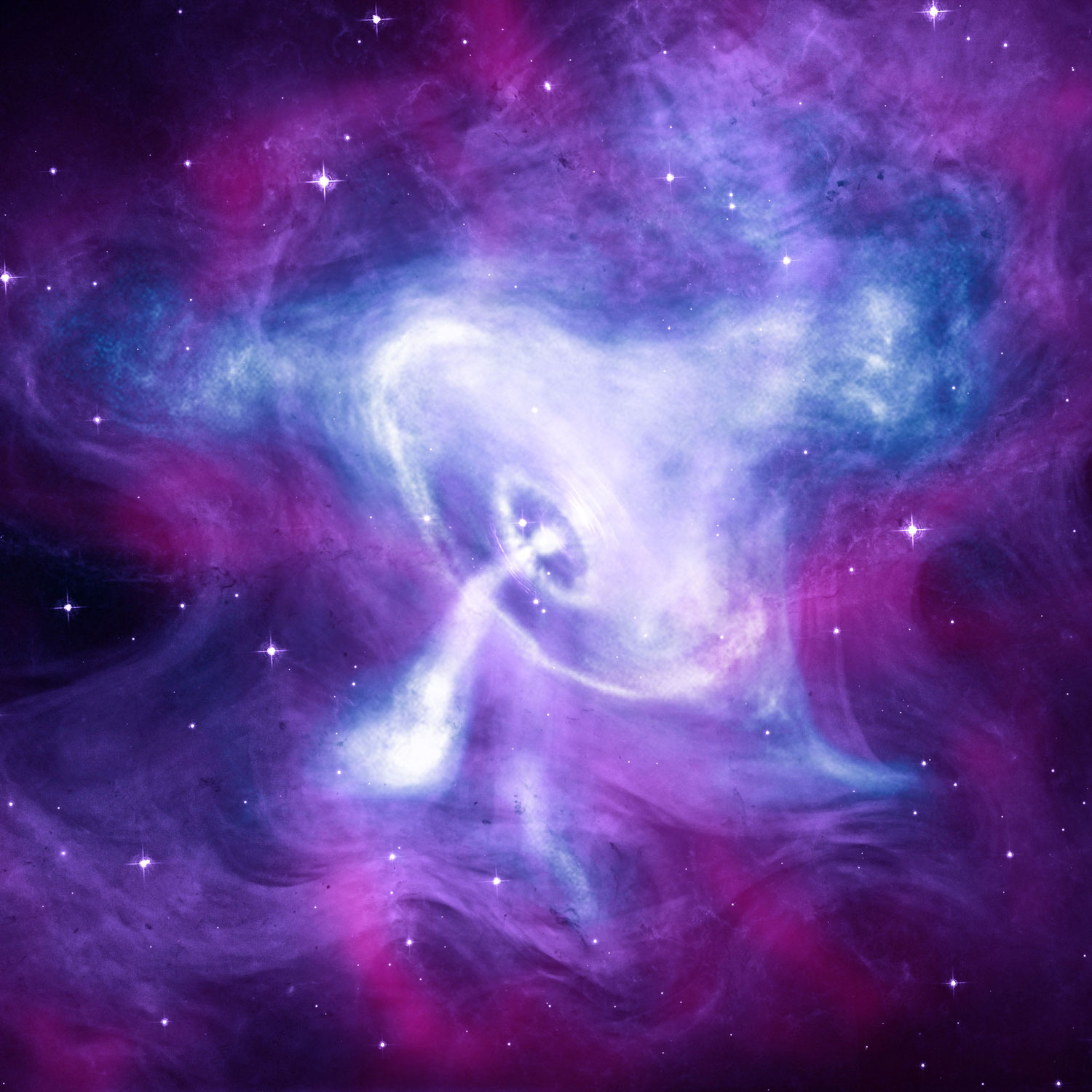
Imagine a star the size of a city spinning 30 times a second. That’s what you’ll find at the heart of the Crab Nebula, a supernova remnant in the constellation Taurus that is located some 6,500 light-years away. It’s known as the Crab Pulsar. As it spins, it accelerates the electrons in the gas clouds of the nebula, resulting in a swirling cosmic lightshow. The Crab Pulsar is the collapsed core of supernova SN 1054, which exploded over 7,500 years ago.
The supernova was visible from Earth by the time the light eventually reached us on July 4th, 1054 CE. It was so bright that it could be seen in broad daylight for 23 days and at night for almost two years. The event was reported extensively at the time in Chinese, Japanese, and Arab records and was depicted in Native American petroglyph art. European sky watchers, curiously, seemed not to record it. No one knows why. Perhaps it just didn’t fit with the prevailing belief that the heavens were unchangeable?
Spinning pulsar of the Crab Nebula spotted by NASA. This image combines visible light from the Hubble Space Telescope in purple, X-ray light from the Chandra X-ray Observatory in blue, and infrared light from the Spitzer Space Telescope in red.