April 09 Cloud of the Month
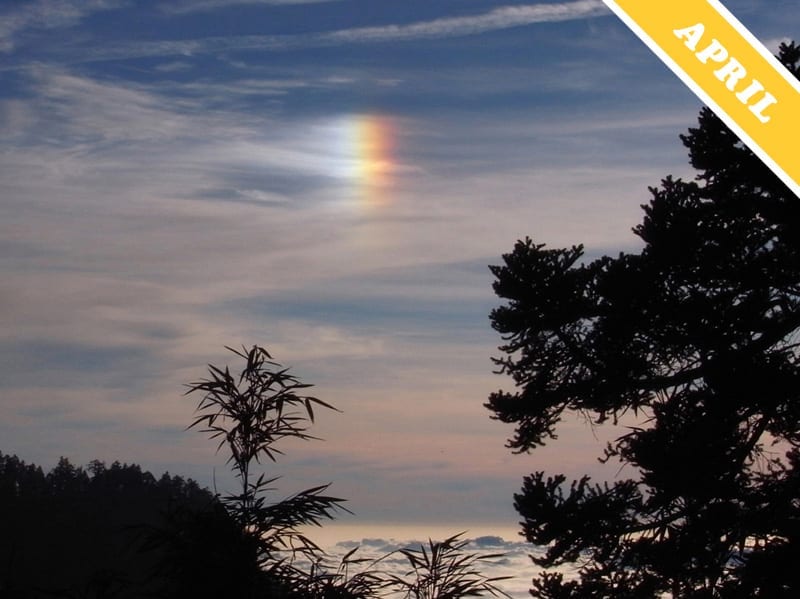
(Click image to enlarge) Photographed over Mount Jade, Taiwan © Jo-chun Ho.
See this photo in the Cloud Gallery here.

April 09 Wiro

Every Sundog Has Its Day

Also known as ‘mock suns’ and ‘parhelia’, sundogs are large spots of light that can appear on one or both sides of the Sun. They appear on about 70 days of the year in mid-latitude regions of the world, and are formed as sunlight is refracted through the ice crystals of thin layers of high clouds, such as Cirrostratus, Cirrocumulus and Cirrus, as is the case in April’s Cloud of the Month. Like all the ‘halo phenomena’ produced by sunlight shining through ice clouds, sundogs can also appear in ground-level ice-crystal cloud known as diamond dust.

These spots of light appear level with the Sun, and at a distance away from it that’s equivalent to the outstretched span of a hand held up at arm’s length. Sundogs are brightest when the Sun is low, and only generally visible when it’s lower than 40˚ above the horizon. They generally appear orange and red on the side nearest to the Sun, because of the way the wavelengths of sunlight are separated by tiny ice-crystal prisms of the cloud.

Cloudspotters should learn to recognise the sort of sky that produces sundogs and other halo phenomena. This is when the blue first begins to pale with subtle wisps and milky patches of the ice-crystal clouds. The clouds must be thin for the light effects to appear. Once they’ve grown thick enough and white enough to be noticed by the general riffraff, the sundogs will have silently slipped away.
 

Current Cloud of the Month:
August 2010

Previous Clouds of the Month:
July 2010
June 2010
May 2010
April 2010
March 2010
February 2010
January 2010
Cloud Reflections (December 09)
Numbers in the Clouds (November 09)
Sun Pillar (October 09)
Convection Clouds (September 09)
‘Pile d’Assiettes’ (August 09)
Cumulus congestus (July 09)
‘Asperatus’ (June 09)
Clouds at Night (May 09)
Sundogs (April 09)
Diamond Dust (March 09)
Cloud Streets (February 09)
Crepuscular Rays (Jan 09)
Valley Fog (December 08)
Cloud Shadows (November 08)
Contrails (October 08)
Mamma (September 08)
Kármán Vortex (August 08)
The Summertime Halo (July 08)
The Nor’west Arch (June 08)
Microbursts (May 08)
Irridescent Clouds (April 08)
Northern Lights – Aurora Borealis (March 08)
Ice halos (February 08)
Lightning (January 08)
Roll Cloud (December 07)
Banner Cloud (November 07)
Stratocumulus (October 07)
The Unclassified Cloud (September 07)
Alexander’s Dark Band (August 07)
Fumulus Snail (July 07)
Distrail (June 07)
Altocumulus undulatus (May 07)
Cumulonimbus capillatus (April 07)
Lacunosus (March 07)
Horseshoe Vortex Cloud (February 07)
Jet-Stream Cirrus (Janurary 07)
Altostratus/Altocumulus/Altowhateveritis (December 06)
Anti-Crepuscular Rays (November 06)
Stratocumulus (October 06)
Altocumulus (September ’06)
The Kelvin-Helmholtz Wave Cloud (August ’06)
The ‘Brocken Spectre’ (July ’06)
‘Whale’s Mouth’ (June ’06)
Noctilucent (May ’06)
Cirrus (April ’06)
Cap Cloud (March ’06)
Fallstreak Holes (February ’06)
Nacreous (January ’06)
Cirrostratus (December ’05)
Tuba (November ’05)
Virga (October ’05)
Cirrocumulus (September ’05)
Altostratus (August ’05)
Cumulus (July ’05)
Mamma (June ’05)
Pileus (May ’05)
Lenticularis (April ’05)
Stratus (March ’05)
Cumulonimbus (February ’05)
Contrails (January ’05)


To contribute a Cloud of the Month,
go to our Photograph Submissions page.

Back to home page