

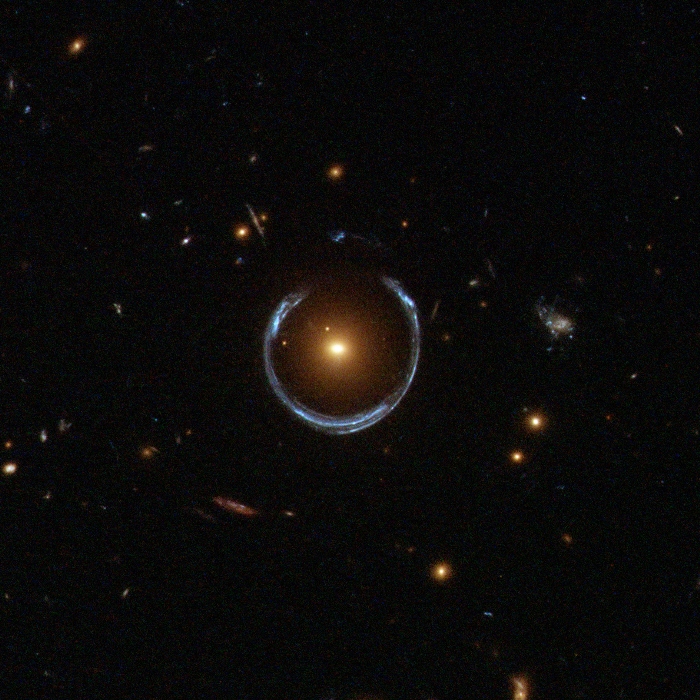
Massive objects such as large galaxies and black holes can warp space and time around them. That is what is causing the ring-like arc of light in this Hubble Space Telescope image. The bright orange point in the middle is a massive luminous red galaxy called LRG 3-757, in the constellation Leo, which is several times more massive than our own galaxy, the Milky Way.
By a phenomenon known as gravitational lensing, this central galaxy is warping the light from a more distant galaxy into this ring. It is like a kind of deep-space mirage. The blue and knotty appearance of the light in the ring suggests that the galaxy beyond is a system of gas and dust clouds that is vigorously forming stars. Since Einstein’s general theory of relativity describes how gravity bends light, such arcs of light are sometimes referred to as Einstein rings. In this case, the alignment of the galaxies is not perfect, so the ring has been distorted into a horseshoe shape. Scientists have speculated, although this remains unconfirmed, that the central galaxy may contain an exceptionally massive black hole that is tens of billions of times the mass of our Sun.
Horseshoe Einstein ring of LRG 3-757, spotted by the Hubble Space Telescope.
Image credit: ESA/Hubble and NASA